Answering the common buyer question: for many DIY painters and professionals, gravity feed spray guns often offer better control and finish for automotive coatings and fine-detail work, while suction or other HVLP setups can excel in larger-area coverage and portability. This guide compares gravity feed versus suction-style HVLP guns, highlights five top Amazon options, and explains who each product is best for. The result is a practical buying guide that helps you pick the right tool for car refinishing, model painting, furniture, or general spray work.
Quick Product Snapshot
| Product | Best For | Capacity | Nozzles Included |
|---|---|---|---|
| JUSTPRO 2-in-1 HVLP Gravity Feed Kit | Best for dual-purpose automotive and model painting | 600 ml + 125 ml | 1.4 mm and 0.8 mm |
| PNTGREEN Gravity Feed Gun | Best for versatile touch-ups and variable spray needs | 600 cc | 1.4 mm |
| ENDOZER HVLP Gravity Feed Set | Best for complete auto coatings with multiple nozzle options | 600 ml | 1.4, 1.7, 2.0 mm |
| HVLP 5-Nozzle Automotive Kit | Best for all-around automotive finishing | 1000 cc | 1.4/1.7/2.0/2.5/3.0 mm |
| Hotorda 2-Sprayer HVLP Set | Best for value-friendly dual-gun setups | 125 ml & 600 ml | 1.0 mm and 1.4 mm |
JUSTPRO 2-in-1 HVLP Gravity Feed Kit
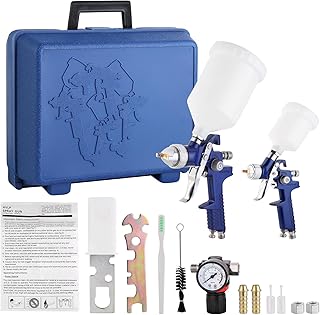
Best for dual-purpose automotive and model painting. This kit includes two nozzles and two cup sizes: a 0.8 mm nozzle with a 125 ml cup for tight spaces and detailing, plus a 1.4 mm nozzle with a 600 ml cup for larger surfaces and higher-viscosity paints. The integrated locking pressure regulator and gauge help maintain consistent atomization to reduce drips and achieve smooth finishes. Suitable for automotive clear coats, epoxy primers, and detailed model work. Caution: the dual-system setup requires careful pressure management to avoid overspray when switching nozzles.
Why it’s selected: It combines gravity-feed versatility with a locking regulator for stable performance and a durable chrome-plated body designed to withstand solvents. Best for buyers who need both automotive and fine-model capabilities in one tool. The dual-nozzle arrangement supports fast coverage on large panels while preserving detail in tight areas.
PNTGREEN Gravity Feed Gun
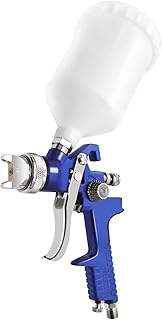
Best for general touching up and flexible spray tasks. This gravity-fed model delivers a 600 cc cup capacity with a 1.4 mm nozzle and three adjustment valves to control liquid volume, air volume, and spray range. The ergonomic handle and light trigger design support comfortable, fatigue-free operation during extended sessions. It’s well-suited for small to medium panels on cars, walls, wood, and metal surfaces. Limitation: the single nozzle size may require frequent switching for different coatings, which can slow work on large jobs.
Why it’s selected: A solid choice for DIYers and hobbyists who want a straightforward, adjustable gun without extra nozzle changes. It emphasizes control over spray pattern and liquid flow, aligning with tasks that demand precision in narrower spaces.
ENDOZER HVLP Gravity Feed Set
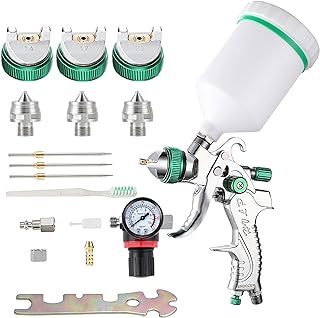
Best for auto coatings with multiple nozzle options. This set includes 1.4 mm, 1.7 mm, and 2.0 mm stainless steel nozzles with a 20 oz (600 ml) gravity feed cup. The brass hood, wear-resistant design, and 15-hole atomization system aim for uniform spray patterns and smooth finishes across various surfaces. The kit features a 1/4″ NPT inlet and a matching quick adapter. Caution: materials compatibility varies; verify that your coatings align with the brass components and stainless steel internals.
Why it’s selected: Choose this for projects that require more nozzle options to tailor spray characteristics, from primers to top coats. It’s optimized for consistent atomization across different viscosity levels, aiding in both coverage and finish quality.
HVLP 5-Nozzle Automotive Kit

Best for all-around automotive finishing. This professional-grade HVLP gun uses gravity feed technology with a wide nozzle set (1.4/1.7/2.0/2.5/3.0 mm), offering a broad range of spray patterns. The gun supports a 1000 cc cup capacity, works at a typical 2.5-3.5 bar (about 36-50 PSI) operating range, and is built with aluminum alloy and brass components for durability. The included 2-in-1 air regulator helps stabilize airflow for uniform coverage. Caution: larger nozzle sizes require careful distance and technique to avoid excessive material usage on small parts.
Why it’s selected: Best for buyers who want a single system that can handle primers, base coats, clears, and topcoats across different vehicle panels without swapping multiple guns. It emphasizes versatility and professional-grade performance.
2-Sprayer HVLP Set (1.0 and 1.4 mm)

Best for dual-gun setups and value-driven projects. This kit includes two gravity-feed spray guns with 1.0 mm and 1.4 mm nozzles, 125 ml and 600 ml cups, and a locking air pressure regulator gauge for precise control. It’s designed for car priming, model building, cake decoration, and craft applications where different spray characteristics are required across tasks. Limitation: smaller 1.0 mm nozzle may not be ideal for heavier coatings or broad mass application where larger nozzles are preferred.
Why it’s selected: Choose this when you need a budget-friendly pair of guns that can handle both detail work and mid-size coverage, with a regulator feature to manage pressure accurately.
Buying Guide: How To Choose Between Gravity Feed And Suction
- A gravity-feed spray gun uses gravity to pull the paint into the nozzle, typically offering larger cups and potentially better material usage efficiency for thicker coatings.
- In suction (or siphon) designs, the paint is drawn from a cup attached below the gun, which can be lighter and more compact, but may have more risk of runoffs with high-viscosity materials.
- Gravity-feed often provides more consistent atomization for high-viscosity paints and clear coats, which helps achieve a smoother finish on automotive panels and smooth models. Look for multiple nozzle options if you plan to coat diverse surfaces.
- Larger cups reduce refill frequency on bigger projects. If you work on walls, furniture, or cars, a 600 ml or larger cup is advantageous; smaller cups save weight for detail work.
- A locking regulator and gauge help maintain stable atomization, minimize drips, and improve repeatability across sessions. This is especially helpful when changing coatings between coats or materials.
- A kit with 1.0–3.0 mm nozzles covers primers, base coats, clears, and top coats. For automotive work, 1.4–2.0 mm are common; for detail or model work, 0.8–1.4 mm can be ideal.
- Look for corrosion-resistant bodies and comfortable triggers for long sessions. Brass and stainless components tend to offer longer life in solvent-rich environments.
- Always verify material compatibility with the gun’s components, especially brass parts and seals when using solvent-based products. Follow manufacturer guidance for air pressure to prevent paint runs and dry spray.
FAQ
- What is the main difference between gravity feed and suction feed? Gravity-feed uses a cup above the nozzle and relies on gravity for paint flow, typically offering larger cups and strong consistency with high-viscosity coatings. Suction feed pulls paint from a lower cup, which can be lighter and more compact but may require more care to avoid runs with thicker coatings.
- Which is better for automotive finishing? Gravity-feed guns with adjustable nozzles and stable pressure are often preferred for automotive finishes due to better control and spray stability, especially for clear coats and primers.
- Do I need multiple nozzles? Yes, having multiple nozzle sizes expands the range of coatings you can apply, from primers to clears, and helps you tailor spray patterns to panel size and material viscosity.
- Is a regulator necessary? A built-in or separate regulator improves control over atomization and reduces the risk of paint runs. It’s especially helpful when switching between different coatings.
- What should I consider for cup capacity? Choose a larger cup for large panels or walls to minimize refills; smaller cups are suitable for detailed tasks and portable setups.
- What maintenance is required? Regularly clean nozzles, seals, and air passages. Replace worn seals and inspect brass and stainless components for corrosion when using solvents.