Answering the question “what is the best water resistant paint for basement surfaces?” this guide highlights five reliable options. Each product is suited for concrete, brick, cinder block, or masonry walls, offering moisture resistance for below-grade spaces. The top picks are ideal for homeowners, DIYers, and contractors who want durable protection without complex prep.
Overview of top products at a glance: the table below summarizes the five selected paints by type, best use case, and surface compatibility. This quick reference helps buyers compare options before diving into detailed product sections.
| Product | Best For | Surface Compatibility | Notes |
|---|---|---|---|
| KILZ Basement And Masonry Waterproofing Paint | General basement walls | Concrete, brick, cinder block | Interior/Exterior |
| Zinsser Perma-White Mold & Mildew Proof | Mold-prone basements | Interior walls | 5-year film guarantee |
| TUFINEIN Rubber Sealant (White) | Elastic waterproof seal | Multi-surface including basement walls | Flexes with movement |
| TUFINEIN Rubber Sealant (Neutral Gray) | Neutral finish for basements | Multi-surface | Flexible, weather resistant |
| AMES Blue Max White Liquid Rubber | Heavy-duty waterproofing below-grade | Concrete, masonry, wood, metal | 900% elongation |
KILZ Basement And Masonry Waterproofing Paint

Best for general basement walls. This paint provides water resistance for concrete, brick, and masonry surfaces and works for both interior and exterior applications. Best for homeowners seeking a single-coat solution to reduce moisture issues on typical basement walls.
Selected for its broad surface compatibility and straightforward application. Cautions include ensuring proper surface cleaning and curing times to optimize film integrity.
Zinsser Perma-White Mold & Mildew Proof

Best for mold-prone basements. This interior paint claims a mold and mildew-proof film with a 5-year guarantee, resisting dirt and moisture buildup on the coating. Ideal for bathrooms, laundry rooms, and basements with higher humidity.
Selected for its dedicated mold/mildew resistance. Note that this is an interior-focused product; use exterior-grade options for outdoor exposure or heavy weathering areas.
TUFINEIN Rubber Sealant White
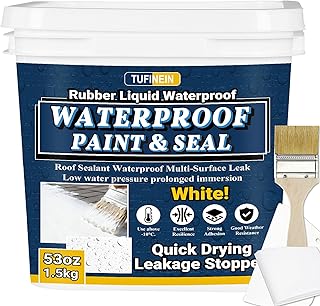
Best for flexible, multi-surface waterproofing. This elastic rubber coating is designed to seal small gaps and cracks, providing lasting waterproof protection. Suitable for basements as an interior or exterior coating on multiple substrates.
Selected for its elasticity and wide adhesion. Limitation: not ideal for walking surfaces due to tackiness when cured; plan for non-traffic areas or sealant-only applications.
TUFINEIN Rubber Sealant Neutral Gray

Best for flexible, neutral-toned basement sealing. This gray sealant offers elasticity to accommodate substrate movement while providing a moisture barrier. It is suitable for multiple surfaces, including concrete and masonry.
Selected for its compatibility with neutral color schemes and its movement tolerance. Caution: cure times and surface preparation vary by substrate; follow product instructions for best results.
AMES Blue Max White Liquid Rubber

Best for heavy-duty basement waterproofing. This elastomeric liquid rubber provides high elongation (900%), expanding and contracting with settling or temperature changes. It is suitable for basements, foundations, and other below-grade areas.
Selected for its superior crack-bridging capability and long-lasting resistance. Limitation: not primarily designed for foot traffic; best used as a coating for walls and tight seal applications rather than floors.
Buying Guide
What should you consider when choosing water resistant paint for a basement?
- Surface type: Concrete, brick, or masonry walls require different adhesion and film-forming properties. Interior vs. exterior exposure also matters.
- Moisture level: High humidity basements benefit from mold and mildew resistance as well as breathable film coatings to prevent trap moisture.
- Elasticity: Flexible sealants are useful when walls may flex or crack slightly; elastomeric coatings often perform better in older structures.
- Access and finish: Choose a product with the finish you need (matt, eggshell, or semi-gloss) to balance moisture resistance and cleanability.
- Preparation: Clean, dry surfaces and proper curing times are essential for optimal film formation and durability.
Interior vs. exterior coatings: what’s the difference?
Interior basement coatings focus on moisture resistance and mold prevention, often with mildewcide ingredients. Exterior coatings must withstand weather exposure and temperature swings, offering higher durability for basement exteriors or walkable areas around foundations.
Application methods: roll, brush, or spray?
Many basement coatings accept multiple application methods. Rolls and brushes are common for walls; sprays may be used for larger areas or textured surfaces. Follow product instructions for film thickness and drying times.
Durability and maintenance
Look for film-forming waterproofing paints with dirt resistance and mold protection. Regular cleaning with mild detergents helps maintain appearance and protective benefits over time.
Buying considerations at a glance
- Best for mold-prone environments: Mold and mildew resistant interior paints.
- Best for flexible substrates: Elastomeric rubber sealants with high elongation.
- Best for broad compatibility: Multi-surface waterproof coatings that work on concrete, brick, and masonry.
FAQ
- Q: Do I need a primer for basement walls before applying water resistant paint?
A: Some products are self-priming; others benefit from a primer for improved adhesion on glossy or very porous surfaces. - Q: Can these coatings be applied to concrete block walls?
A: Yes, most basement-focused moisture paints are suitable for concrete block and masonry surfaces when properly prepared. - Q: Are these products safe for living spaces after curing?
A: Most basement coatings are designed for indoor use; verify VOC content and curing times per product. - Q: How long should I wait before repainting or finishing the basement?
A: Curing times vary by product; follow the label for exact durations before applying a second coat or finishing touches. - Q: Which product is best for high humidity basements?
A: Mold and mildew resistant interior coatings are typically best for environments with persistent humidity. - Q: Can I use these coatings on floors?
A: Many are formulated for walls; use floor-specific sealants if floor exposure is required and avoid coatings not rated for walking surfaces.