When choosing a tool for molding work, accuracy and ease of use are priorities. This guide highlights five top contour gauges and angle finders that excel at copying profiles, aligning angles, and shaping trim with minimal guesswork. These options are ideal for DIYers, carpenters, and professionals tackling crown molding, baseboards, door casings, and tile layouts. The top picks include models with locking features, dual-scale measurements, and durable materials to support precise, repeatable results.
Summary table of chosen products:
| Product | Best For | Key Benefit | Locking / Precision Notes |
|---|---|---|---|
| JOREST Connectable Contour Gauge | Tight spaces to mid-size profiles | Three-size versatility via splicing (5″, 10″, 15″) | Locking option; dual inch/centimeter scales |
| General Tools Contour Gauge 837 | General profile duplication | 35 leaves-per-inch with deep measuring up to 3″ | Ultra-thin pins; rust-resistant |
| LEXIVON Aluminum Miter Saw Protractor | Precise miter and inside/outside angles | Laser-engraved scales; smooth operation | Internal O-ring for steady readings |
| GemRed 7In Digital Angle Finder | Electronic angle measurements | ±0.3° accuracy; clear readout | Digital readout with stainless steel ruler |
| Feeke Contour Gauge (12 Inch) | Large contour profiles | Dual scales; locking feature; wide 12″ | High-precision pins; adjustable tightness |
JOREST Connectable Contour Gauge (10+5 Inch)

This contour gauge combines 5-inch and 10-inch segments to form 5″, 10″, and 15″ profiles. It is designed for precise shape replication and is well-suited for tight spaces as well as larger surfaces. The dual-scale layout (inches and centimeters) supports clear measurements during molding projects. The blade thickness is slim, aiding accuracy, and adjustments can be made with a small screwdriver to control tension. Best for DIYer projects in tile, wood, and paneling where contour tracing is essential.
Who it’s best for: Home improvement enthusiasts and hobbyists who need a flexible gauge that expands across multiple project sizes. Why selected: the three-size capability reduces the need to buy multiple gauges, saving time and space. Caution: ensure the locking mechanism is tightened properly to hold traces during transfers.
General Tools Contour Gauge 837

The 6″ contour gauge uses ultra-thin, rust-resistant pins to accurately capture complex shapes. With 35 leaves-per-inch and a depth capacity up to 3″ (76mm), it records cross-sectional profiles with high detail, making it a reliable choice for door casings, tile edges, and irregular moldings. The ruler markings on the body provide quick reference during layout work.
Who it’s best for: Professionals or serious hobbyists needing precise, repeatable shape duplications for woodworking and tiling. Why selected: the high pins density translates into finer detail. Caution: plastic components may be less durable under heavy use; handle with care in dusty environments.
LEXIVON Aluminum Miter Saw Protractor
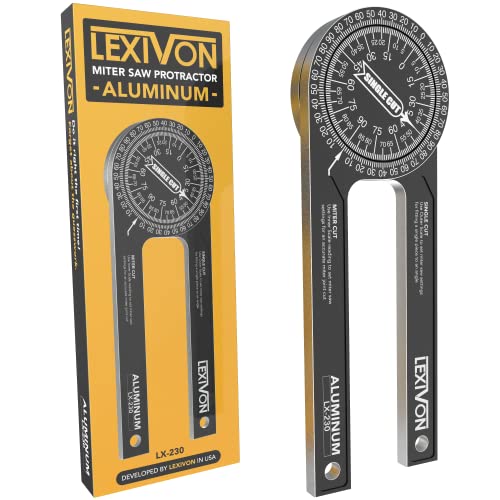
This aluminum protractor uses precision laser-engraved scales for easy, accurate angle readings. Its internal Teflon O-ring minimizes friction and provides smooth operation for inside and outside corners. The tool directly transfers measured angles to a miter saw, helping users avoid guesswork when cutting crown molding or trim pieces. Best for: carpenters and DIYers who want quick, reliable angle reads for reliable cuts. Caution: ensure the O-ring remains clean and lubricated for longest service life.
GemRed 7In Digital Angle Finder

This digital angle finder combines a ruler and protractor in one tool for easy inside and outside angle measurements. The stainless steel rulers and laser-etched scale provide solid durability and clear readings. Accuracy is stated at ±0.3 degree, making it a good option for precise molding and trim work across home improvement projects. Best for: users who prefer digital readouts and quick angle verification. Caution: batteries may be required for operation; plan for replacement when needed.
Feeke Contour Gauge (12 Inch)

This 12-inch contour gauge offers a larger tracing surface for extensive molding profiles. It includes dual scale design on both sides (inch and centimeter) for precise measurements, plus a locking feature to hold shapes in place after tracing. The tool uses ABS plastic with a reduced pin thickness of 0.05 inches, enabling better fidelity when copying complex contours. Best for: larger projects and profiles such as baseboards, crown molding, and wide tile edges. Caution: heavier gauge can be less convenient in tight spaces; choose a smaller gauge for narrow alcoves.
Buying Guide: Key Considerations For Contour Gauges And Angle Finders
- Profile size and versatility: For small tight spaces, 5″ or 6″ gauges perform best. For larger surfaces, 12″ or 15″ gauges reduce the number of transitions between tools.
- Locking capability: Tools with a locking feature prevent shifts while tracing or copying a profile, improving repeatability on repeated cuts.
- Scale clarity: Dual inch/centimeter scales help cross-check measurements, especially when following plans that use metric units.
- Material durability: Stainless steel pins and anodized aluminum offer longer life and smoother movement than basic plastic components.
- Digital vs. analog readings: Digital protractors provide quick angles with clear displays; analog gauges rely on pins and scales but may perform better in bright lighting or dusty environments.
- Transfer accuracy to cuts: Tools that align closely to saws or marking tools reduce the need for rework and improve overall project efficiency.
- Ease of use in molding tasks: Look for tools with compact profiles, easy lock adjustments, and smooth operation to facilitate repetitive molding tasks.
FAQ
- What tool is best for crown molding angles? – A protractor or digital angle finder with precise scales and easy transfer to a miter saw is ideal for crown molding, such as the LEXIVON Miter Saw Protractor or GemRed Digital Angle Finder.
- How do contour gauges improve tile layout? – Contour gauges copy irregular shapes exactly, enabling accurate tile and trim cuts around outlets, pipes, and contours without guesswork.
- Should I choose a digital or analog angle finder? – Digital finders offer quick readings and easy visibility, while analog gauges are durable and simple in dusty environments. Your choice depends on work conditions and personal preference.
- Can contour gauges be locked? – Yes, many models provide a locking feature to hold a traced profile for accurate transfer to cuts or layouts.
- What is the ideal gauge size for baseboard work? – A mid-range gauge (6″ to 12″) typically provides enough coverage for standard baseboard shapes and most interior moldings.
- Are dual-scale gauges worth it? – Dual-inch/centimeter scales are helpful when following designs or plans that use different units, improving measurement accuracy.