Answering the common question, this guide highlights top grey-dominated paints and markers to help you choose the right shade for art, crafts, and decorative projects. Ideal buyers include students and hobbyists seeking reliable neutrals, professional painters needing controlled greys, and DIY crafters wanting consistent tones across multiple surfaces. Below, compare five relevant products, plus a concise buying guide and FAQs to aid quick decisions.
Quick comparison table
| Product | Best For | Key Point |
|---|---|---|
| 12 Shades of Grey Acrylic Paint Colors – Warm Grey | Acrylic painters needing warm neutrals | Rich warm grey tones with triple milled pigment |
| 12 Shades of Grey Acrylic Paint Colors – Green Grey | Subtle cool-greys for modern palettes | Balanced green-tinged greys for depth |
| Paynes Grey 75ml Acrylic | Shadows, underpaintings, moody scenes | Classic dark grey for tonal contrast |
| 12 Shades of Grey Acrylic Paint Colors – Set of 12 | Comprehensive grey palette for varied effects | Varied greys for shadows, highlights, and neutrals |
| Guangna 12 Grey Dual Tip Acrylic Paint Markers | Craft projects on non-traditional surfaces | Dual tips for detail and broad coverage |
12 Shades of Grey Acrylic Paint Colors – Set of 12 Assorted Greys

Best for: Artists and crafters who want a complete grey spectrum in acrylic form. The set delivers 12 distinct grey tones designed to create depth, shadows, and subtle tonal ranges without muddying colors. The triple milled process enhances pigment density for clean blending.
Why chosen: This set focuses on hard-to-find greys with high pigment load, enabling under-painting and nuanced shading. It’s ideal when you need a full grey ladder for portraits, architectural studies, or moody abstracts. A potential limitation is storage space; 12 tubes fill a compact kit more quickly than single-tone bottles.
12 Shades of Grey Artist Oil Colors – Set of 12

Best for: Oil painters seeking rich, slow-drying greys with strong pigment and a triple milled finish. The oil base allows longer blending times and richer textures for shading and atmospheric effects.
Why chosen: The triple milled, highly pigmented oils provide smooth color transitions and deep tonal ranges. It’s better for traditional oil techniques and layering. Limitation: Oil paints require handling and drying times different from acrylics, and may need solvents for cleanup.
12 Shades of Grey Acrylic Paint Colors – Warm Grey 75ml
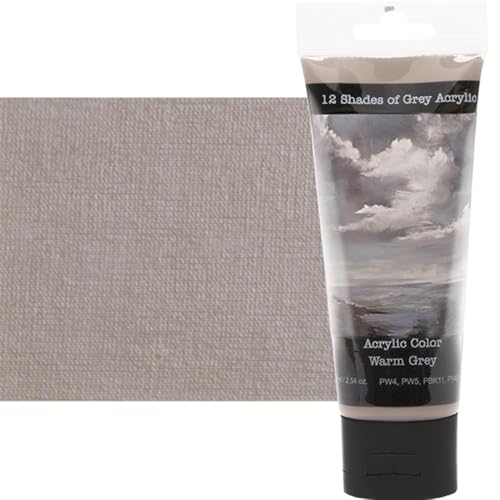
Best for: Medium to large acrylic art projects requiring stable warm grey tones with smooth application. The 75ml size offers more volume for extended sessions.
Why chosen: Warm grey tones help create natural skin tones, architectural renderings, and vintage effects. A caution: color shifts may occur when layering over vs. under white or black acrylics, so test blends first.
12 Shades of Grey Acrylic Paint Colors – Green Grey 75ml

Best for: Artists building cool-toned grey palettes with a hint of green for depth and modern scenes. The 75ml bottle size suits mid-sized canvases and crafts.
Why chosen: Green Grey adds a subtle shift in undertone that helps differentiate grey zones in landscapes and interiors. Limitation: Green undertones may complicate precise color matching in projects that require pure greys alone.
Guangna 12 Grey Dual Tip Acrylic Paint Markers

Best for: Crafters and designers who need precise lines and bold coverage on rock, wood, glass, and paper. The dual-tip design supports both detail work and broad strokes.
Why chosen: The markers provide high-opacity, quick-drying coverage with a waterproof finish once dry, making them versatile for mixed-media projects. Caution: Markers may require multiple coats on very dark surfaces to achieve full opacity.
Buying Guide
What kind of gray paints should I choose?
Consider the base medium: acrylics dry quickly and are great for layering on canvas, wood, and paper. Oils offer richer texture and longer blending times but require solvents and longer setup. Choose sets that include a range from light to dark greys to maximize blending options.
How do I pick the right grey for portraits or shading?
For portraits, start with warm greys for skin tones and cool greys for shadows. A Payne’s Grey or similar deep grey is ideal for moody shadows, while mid-tones fill out form without overpowering highlights.
Are grey markers a good supplement to paints?
Yes. Dual-tip grey markers are excellent for quick drawings, outlines, or adding consistent accents on non-porous surfaces. They pair well with acrylics for mixed-media projects but may require sealant on certain surfaces to prevent bleed-through.
What about pigment quality and durability?
Look for triple milled pigments and highly pigmented formulations when possible. These features improve color consistency, reduce muddy blends, and yield smoother gradients essential for realistic shading.
Which set offers the best value?
A full set of 12 greys provides the broadest tonal range for versatile projects. If you only need a few shades, 75ml jars give more volume for ongoing work, while markers add convenience for quick sketches and on-the-go use.
How should I store and care for these paints?
Keep containers tightly closed, stored in a cool, dry place away from direct sunlight. For acrylics, avoid prolonged exposure to air to prevent skin formation on the surface. Oil colors require proper ventilation and solvent-safe storage guidelines.
FAQ
- What is the best gray for beginners? Start with a mid-toned grey from a reputable set; it is easier to blend into lighter and darker shades.
- Can I mix these greys with other colors? Yes. Greys blend well with whites, blacks, blues, and earth tones to adjust warmth and coolness.
- Do the markers work on dark surfaces? They offer high opacity on many surfaces but may require base coats or layering for full coverage on very dark substrates.
- Are these greys suitable for murals? Yes, particularly the acrylics, which dry quickly and resist minor fading in indoor settings; outdoor durability depends on sealer use.
- Which product is best for fine-detail work? Dual-tip markers provide precise lines that complement brush-based painting for outlines and accents.
- Do these paints require primers? In most cases, a white or light-gray primer helps achieve consistent color, especially on porous surfaces.