Answering the question “What primer should I use for an epoxy countertop?” this guide highlights top primers and undercoats that create a solid foundation for epoxy applications. The best picks are suited for DIYers and professionals working with laminate, wood, and porous surfaces. Each product is evaluated for adhesion, odor, and compatibility with Stone Coat Countertops epoxy systems. A quick summary table helps you compare suitability at a glance.
| Product | Best For | Key Benefit |
|---|---|---|
| Stone Coat Bonding Primer & Sealer | Slick surfaces (laminate, tile, cultured marble) | Improved adhesion with low odor |
| Stone Coat Epoxy Undercoat White | Bar tops, MDF, plywood | Denser, thicker look with two coats |
| NADAMOO All Surface Primer Spray | Enhances adhesion on challenging substrates | |
| Stone Coat Epoxy Undercoat Black | Bar tops, porous surfaces | High-bond undercoat for durability |
Stone Coat Bonding Primer & Sealer

The Bonding Primer & Sealer creates a durable bond on slick surfaces such as laminate, tile, granite, quartz, solid surface, and cultured marble. It is designed as a strong foundation for epoxy applications and serves as an upgraded replacement for older primers. Best for projects where the substrate is shiny or non-porous and requires enhanced adhesion. It is formulated with low-odor, low-VOC characteristics for indoor use.
Best for: DIYers and professionals working with slick countertop substrates who need reliable adhesion and a comfortable application experience. Limitations: do not rely on it alone for long-term topcoat protection; pair with a compatible epoxy system for best results.
Stone Coat Epoxy Undercoat White

The Epoxy Undercoat White is essential for creating a firm, sealed foundation. Apply two coats to achieve a denser, thicker look and extend surface longevity. Suitable for surfaces including countertops, table tops, bar tops, and cabinets. Designed for use with Stone Coat Countertops epoxy resin kits to help the final finish look refined with high gloss potential.
Best for: Projects requiring a solid base that improves both strength and appearance. Limitation: intended for use with Stone Coat epoxy kits; mixing with other resin systems may yield unpredictable results.
Stone Coat Epoxy Undercoat White (Alternate)

This Epoxy Undercoat White variant provides similar benefits with two coats for a firm foundation on porous and MDF-based surfaces. It is compatible with the Stone Coat system and helps achieve better adhesion and surface uniformity. Best for: DIYers seeking a proven white undercoat to pair with epoxy resin kits. Caution: verify compatibility with your substrate before use.
NADAMOO All Surface Primer Spray
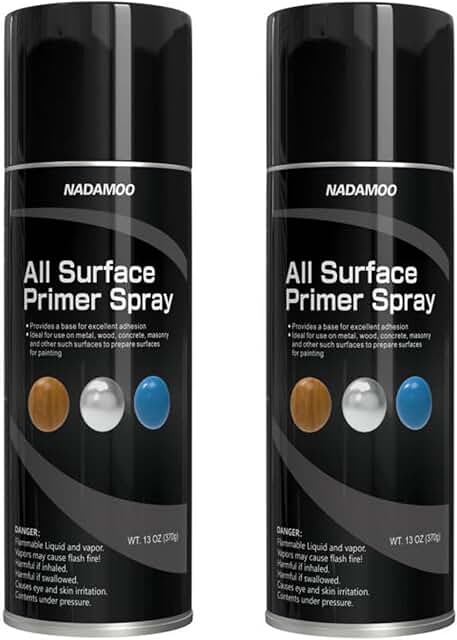
This matte black, all-surface primer spray is formulated to seal and create a smoother, more even finish. It enhances adhesion between top coats and substrates, enabling regular paints to adhere to difficult surfaces. The formula uses modified epoxy resins to boost adhesion and resistance to corrosion and chemical damage. Best for: projects where you need a versatile primer on challenging materials. Limitation: spray format may require ventilation and careful masking for precise application.
Stone Coat Epoxy Undercoat Black

The Epoxy Undercoat Black provides a high-bond foundation for bar tops and porous surfaces. It supports a durable epoxy seal by forming a strong base for subsequent resin layers. Best for: projects that benefit from a darker base to enhance final color depth. Limitation: ensure compatibility with your epoxy color choices to avoid undesired tint transfer.
Buying Guide: Key Considerations For Epoxy Countertop Primers
- substrate compatibility: Are you working with laminate, wood, MDF, plywood, or porous surfaces? Pick an undercoat or primer designed for that substrate.
- adhesion strength: For slick or non-porous surfaces, choose primers labeled for high adhesion and compatibility with epoxy resins.
- odor and VOCs: Low-odor and low-VOC formulas are preferable for indoor use in residential spaces.
- compatibility with epoxy kit: Some undercoats are designed to be used specifically with Stone Coat Countertops epoxy kits; ensure cross-compatibility if using a different resin system.
- application method: Sprays versus brush/roller formats—consider ventilation, masking, and the size of the project.
- finish effect: White undercoats often create a brighter base; black undercoats can deepen color depth and contrast in final epoxy layers.
- cure times and layering: Verify how many coats are recommended and whether sanding between coats improves adhesion and finish smoothness.
Frequently Asked Questions
- What primer should I use before epoxy countertop resin?
Choose a bonding primer or epoxy undercoat recommended for your substrate (e.g., slick laminate, MDF, or porous surfaces). - Can I mix primers from different brands with Stone Coat epoxy?
It is best to use primers designed for compatibility with your epoxy system to ensure adhesion and finish quality. - Is a black undercoat better than white for epoxy countertops?
A black undercoat can deepen color depth, while white undercoats create a brighter base; select based on the desired final look. - Do I need to sand between primer coats?
Sanding between coats is often recommended to improve adhesion, but follow the product’s instructions for best results. - Are low-odor primers safe for indoor use?
Yes, many low-VOC or low-odor formulas are designed for indoor projects, reducing fumes during application. - How many coats should I apply?
Two coats are common for undercoats to ensure a dense, uniform base before applying epoxy.