Answering the needs of buyers seeking low-VOC metal primers, this guide compares 5 popular options that help prevent rust, prime evenly, and support durable finishes. Each pick targets specific use cases—automotive restoration, marine projects, direct-to-metal work, and routine home repairs. The table below highlights key strengths to help you decide quickly.
| Product | Best For | VOC/Formation Note | Why It Stands Out |
|---|---|---|---|
| 2-in-1 Rust Converter & Metal Primer — Black | Automotive and maritime projects needing speed | Low VOC, Water-based | One-step rust conversion and priming saves time |
| Eastwood Low VOC Black Epoxy Primer Part A | Direct-to-metal priming with strong adhesion | Low VOC epoxy primer | Fast-drying, sandable, durable adhesion |
| 2.1 Low VOC DTM Epoxy Primer & Sealer | Direct-to-metal coating with sealing | Low VOC, epoxy | Sealer and primer in one for strong metal protection |
| Duraxell 3-in-1 Rust Converter & Primer | Rusty or previously corroded metal | Low VOC, ready-to-apply | Converts rust and primes in one step |
| Rust-Oleum Bondz Maximum Adhesion Primer | Topcoat compatibility and general priming | Low VOC water-based | Excellent adhesion and flexible use with many topcoats |
2-in-1 Rust Converter & Metal Primer — Black

This low-VOC, water-based product combines rust conversion with priming in a single step. Best for automotive, maritime, or DIY metal projects where reducing prep steps matters. It treats up to 1,000 sq ft per gallon when diluted up to 15%, delivering minimal prep time and cost per square foot. The formulation supports brushing, rolling, or spraying to accommodate different project sizes.
Who this is best for: hobbyists or small shop projects needing fast turnaround and a simplified workflow. Caution: performance depends on proper dilution and surface cleanliness; if the rust is heavy, additional steps may still be necessary.
Eastwood Low VOC Black Epoxy Primer Part A
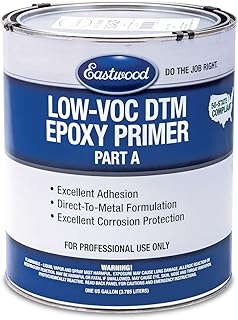
Direct-to-metal epoxy primer designed for steel, fiberglass, aluminum, and more. It offers excellent adhesion and fast drying, with sandability after 2–3 days. Coverage is typically sufficient for around 140 square feet per gallon per coat. This is a strong choice for users who need a durable, paint-ready surface and plan multiple finish layers.
Who this is best for: automotive and metal fabricators requiring reliable adhesion and a solid base for topcoats. Caution: standard ventilation and proper mixing are essential for best results.
2.1 Low VOC DTM Epoxy Primer & Sealer, White Quad Kit

This white direct-to-metal epoxy primer serves as both sealer and primer. It’s suited for projects where clean, bright undercoats help reveal surface imperfections early, and where moisture barriers are important. The kit format is convenient for larger projects or when you want consistent batch control.
Who this is best for: professionals wanting a reliable DTM epoxy that doubles as a sealer. Caution: epoxy systems require precise mixing ratios and compatible topcoats.
Duraxell Rust Converter & Metal Primer

Duraxell 3-in-1 rust converter, primer, and protectant converts rust and seals metal surfaces in a single application. It dries to a touch in about 15 minutes, with full cure in 24–48 hours, depending on temperature. The product is designed for use on automotive frames, trailers, and outdoor metal structures, offering durable protection against moisture and air.
Who this is best for: projects requiring swift rust neutralization and subsequent priming without sanding. Caution: multiple thin coats yield the best coverage and rust protection.
Rust-Oleum Bondz Maximum Adhesion Primer

Bondz is a water-based, low-VOC primer designed for maximum adhesion to diverse topcoats, including solvent-based and two-component epoxies. It supports typical topcoat recoat times—about 1 hour to topcoat with standard paints, or 6 hours with epoxies. This primer is versatile for metal, concrete, and other hard, dense surfaces.
Who this is best for: projects needing a reliable primer that works well with a broad range of topcoats. Caution: ensure proper surface prep for optimal bonding on highly corroded or very smooth metals.
Buying Guide: Key Considerations for Low VOC Metal Primers
- Direct-to-metal (DTM) capability: If you aim to skip sanding, look for DTM formulations that seal and prime in one step.
- Rust treatment vs. rust hiding: Decide whether you need a rust converter that neutralizes or a primer that merely covers existing corrosion.
- Adhesion and surface compatibility: Match primer type (epoxy, acrylic, water-based) to your substrate (steel, aluminum, fiberglass) and intended topcoat.
- Drying and curing times: Consider project timelines; some primers dry to touch quickly, while others require longer cure before sanding or topcoating.
- VOC compliance and safety: Low-VOC formulas reduce odors and emissions; ensure proper ventilation and follow label directions for safe use.
- Application method: Choose based on project size and equipment—brush, roller, or spray-friendly options offer flexibility.
- Topcoat compatibility: Verify that your chosen topcoat is compatible with the primer to avoid adhesion failures or peeling.
FAQ
- What is the main advantage of low-VOC metal primers?
They reduce fumes and environmental impact while maintaining effective rust protection and adhesion. - Can I use a rust converter directly under paint?
Yes, many rust converters also act as primers, but check product instructions for topcoat compatibility. - Is direct-to-metal priming suitable for all metals?
DTM works well on many metals, but extremely smooth or coated surfaces may require surface sanding or prepping for adhesion. - How long should I wait before topcoating after priming?
Drying times vary by product; refer to the label, but many primers are ready for topcoats within hours. - Are low-VOC primers as durable as traditional formulations?
Many low-VOC primers offer comparable adhesion and durability, with added safety benefits; verify compatibility with your topcoat and environment. - Should I use a separate rust converter and primer?
It depends on rust severity and project needs; single-step products can save time, while heavier rust might require a dedicated converter first.