Yes—these epoxy caulks and concrete anchors are designed to fill cracks, seal joints, and secure rebar or bolts in concrete. This guide highlights five top options suited for different needs: moisture resistance, fast curing, large crack filling, or multi-surface compatibility. Best for professional-grade anchoring, DIY repairs, or projects in damp environments. The following picks help you decide who each product is best for and why it stands out.
| Product | Best For | Key Benefit |
|---|---|---|
| PC Products 72561 PC-Concrete | Professional repairs | Moisture-resistant high-tack paste |
| Akona Fast-Setting Anchoring Epoxy | Fast projects | 12-minute set, 16-hour dry time |
| DCP Donseal PU440 | Big joints | Elastic polyurethane for wide expansion joints |
| DCP Quickmast AE15 | Rebar and heavy loads | High-strength epoxy acrylate |
| Rust-Oleum Concrete Crack Filler | Damp surfaces | Moisture-insensitive epoxy repair |
PC Products 72561 PC-Concrete Epoxy Adhesive Paste
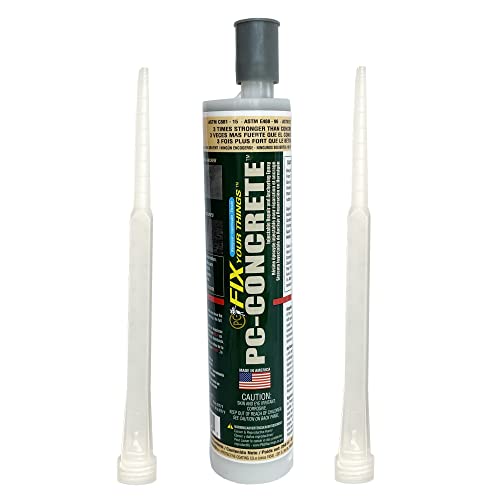
Best for: professional crack repair and anchoring in concrete. This two-part epoxy paste fills cracks and anchors threaded rods, bolts, and dowels into concrete, grout-filled blocks, and unreinforced masonry. It resists moisture, enabling vertical and damp-environment applications. Suitable for indoor and outdoor use with an application temperature range from 35 to 115 degrees F and a service range from -20 to +115 degrees F. Choosing this product works well where moisture exposure and vertical installation are concerns.
Why selected: Its high-tack, moisture-resistant formulation supports durable bonds in challenging conditions. It excels for structural anchors and crack repairs where long-term stability matters. A limitation is the handling time in cooler temperatures, which may extend cure duration.
Akona Fast-Setting Anchoring Epoxy
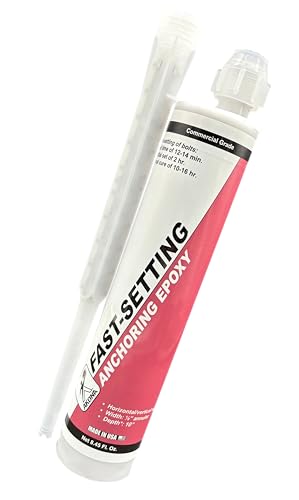
Best for: quick embedment projects and small-to-mid scale anchors. This high-strength, moisture-tolerant epoxy sets in about 12 minutes and dries fully in 16 hours, with a no-mess application tube. It is suitable for concrete, rebar, steel, and masonry. Best for time-sensitive installations where speed matters, such as seasonal maintenance or modular builds.
Why selected: Its fast cure supports faster project timelines. Consider potential limitations in very heavy load scenarios or extreme temperature fluctuations where longer cure windows could be advantageous.
DCP Donseal PU440 Polyurethane Concrete Sealant

Best for: expansion joints and wide-seam sealing on concrete surfaces. Donseal PU440 is a polyurethane caulk that remains elastic after curing, tolerates -22°F to 175°F, and adheres to concrete, wood, metal, ceramic, and more. It forms a durable bond in dry, wet, and water-filled holes, and accepts paints after curing. Ideal for sidewalks, foundations, and areas with progressive movement.
Why selected: The polyurethane formula accommodates joint movement better than rigid epoxies. A caution: polyurethane typically requires moisture to cure; ensure proper surface preparation and curing conditions to achieve best results.
DCP Quickmast AE15 Concrete Epoxy
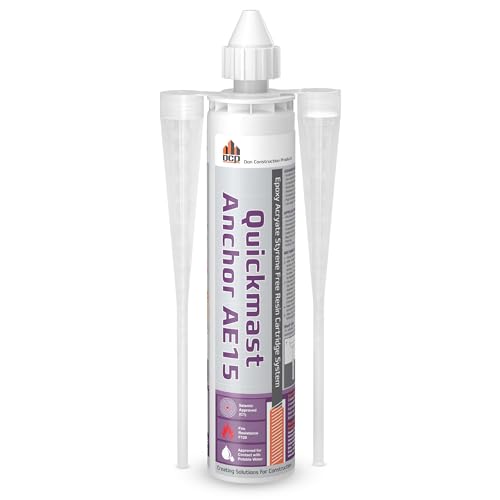
Best for: anchoring rebar and rods with a fast approach for heavy-duty loads. This two-part epoxy acrylate anchor system offers a 4 to 10-minute working time and full load-bearing capacity within 40 to 145 minutes depending on base material temperature. It includes a 10.1 fl oz cartridge for easy caulking-gun application. Choose this if you need rapid curing on concrete with high structural requirements.
Why selected: It provides a robust anchoring solution for critical fixtures. Limitation: cure time can vary with ambient temperature, which may affect project scheduling.
PC Products PC-Concrete 3-Pack Epoxy Adhesive Paste

Best for: mixed repair and anchoring tasks where multiple applications are needed across different sites. This 3-pack includes the same two-part epoxy paste as the single unit, suitable for crack filling and anchoring into concrete, with moisture resistance for damp environments and vertical applications. Supporting both indoor and outdoor use, it maintains performance across a broad temperature range of 35 to 115 degrees F (application) and -20 to +115 degrees F (service).
Why selected: Great value for crews performing several repairs or replacements. A limitation is that each tube shares the same handling characteristics, so plan cure times accordingly for concurrent tasks.
Buying Guide: Epoxy Caulk For Concrete Essentials
What to consider when choosing epoxy caulk or anchoring epoxy:
- Purpose: Repair cracks, anchor bolts, or fill joints? Align product type (paste epoxy vs. polyurethane caulk) with your primary task.
- Moisture and environment: Some formulas resist moisture better or cure in damp conditions; others offer superior elasticity for joints.
- Cure time: If you need speed, prioritize fast-setting epoxies or quick-drying formulations. Temperature during application can affect cure times.
- Substrate compatibility: Ensure the product adheres to concrete, masonry, metal, or other substrates involved in your project.
- Temperature range: Check both application and service temperature ranges to match climate and project location.
Application Tips
- Prepare surfaces by cleaning dust, oil, and loose material for better adhesion.
- Use correct cartridge size and caulking gun for consistent extrusion.
- Follow curing times relative to ambient temperature and humidity to avoid premature loading.
FAQ
- What is epoxy concrete adhesive best used for?
– It is typically used for anchoring bolts, rebar, and dowels, and for sealing cracks in concrete. - Can epoxy caulk be used outdoors?
– Yes, many epoxy products are suitable for indoor and outdoor use with appropriate temperature ranges. - How long does epoxy take to cure?
– Cure times vary by product; some set in minutes while others require hours, depending on temperature and humidity. - Is polyurethane better than epoxy for joints?
– Polyurethane offers elasticity and movement tolerance, which can be advantageous in expansion joints. - Do I need a primer before epoxy?
– Most epoxies don’t require a primer, but proper surface cleaning and occasional bonding agents may be recommended for difficult substrates.