The best concrete paint sealers for basements protect against moisture, dampness, and leaks while improving wall appearance. This guide targets homeowners, contractors, and DIY enthusiasts seeking reliable basement waterproofing with paintable finishes. Below, you’ll find five top products chosen for versatility, performance, and practical application in below-ground environments. A quick comparison table helps you spot key differences at a glance.
| Product | Best For | Key Benefit | Notes |
|---|---|---|---|
| KILZ Basement and Masonry Waterproofing Paint | General basement walls and masonry | Blocks water pressure up to 12 PSI | Not for floors or walls with active leaks |
| Ames Block & Wall Liquid Rubber | Basements and foundations | Waterproofing membrane with sealing capability | White finish; may require multiple coats |
| UGL Drylok Gray Basement & Masonry | Interior/exterior damp basements | Stops leaks and dampness with latex base | Texture and tintable; confirmation needed for exact surface |
| Zinsser WaterTite | Basements and damp spaces | General waterproofing with good coverage | White finish; may require priming on porous surfaces |
| Liquid Rubber Foundation Sealant | Active leaks and foundation repairs | Flexible elastomeric membrane with high elongation | Professional-grade; longer cure time may apply |
KILZ Basement and Masonry Waterproofing Paint

KILZ Basement and Masonry Waterproofing Paint is designed to create a water barrier on concrete and masonry surfaces. It is suitable for both interior and exterior use, making it versatile for basement walls, brick, stucco, and cinder blocks. The nanotechnology-based formula aims to block up to 12 PSI of water pressure, helping reduce infiltration in non-leaking but damp basements. Best for homeowners seeking a paintable waterproofing solution that doubles as wall finish. Caution: do not apply to floors or walls with active leaks; prep with hydraulic cement for holes and cracks.
Ames Block & Wall Liquid Rubber

Ames Block & Wall Liquid Rubber provides a flexible, durable coating designed for basement and foundation use. Marketed as a multipurpose sealant, it functions as a concrete sealer and waterproofer, offering a white finish suitable for interior applications. Best for projects needing a robust waterproof membrane beyond traditional paint. Consider that it may require proper surface preparation for optimal adhesion; some users report needing more than one coat for visible results.
UGL Drylok Gray Basement & Masonry

Drylok Gray is a latex-based masonry waterproofing product designed to stop leaks and dampness. It is suitable for both interior and exterior use with a sandy texture and tintable finish. Best for homeowners needing a traditional waterproof coating that balances ease of use with effective moisture resistance. Limitation: verify surface porosity and ensure proper priming or surface prep for best results on highly damp areas.
Zinsser WaterTite General Purpose
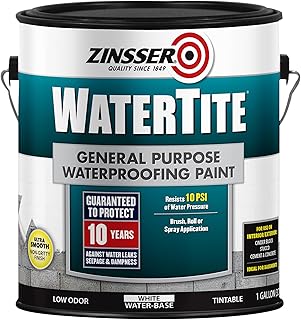
Zinsser WaterTite is a general-purpose waterproofing paint intended for damp basements and cellars. It covers substantial areas depending on wall porosity and application method and resists moderate water pressure. Best for projects needing reliable, straightforward waterproofing with a paintable finish. Limitation: performance can vary with highly porous surfaces; priming may improve adhesion and coverage.
Liquid Rubber Foundation Sealant

Liquid Rubber Foundation Sealant offers a flexible elastomeric membrane designed for basement waterproofing and foundation repair. It provides high elongation (up to 900%), helping accommodate movement and cracks. Best for serious leak prevention and projects that require a durable, crack-bridging seal. Limitation: as a professional-grade product, it may require longer curing and careful surface preparation for optimal adhesion.
Buying Guide: Concrete Paint Sealers For Basements
What should I consider before choosing a basement sealer?
Assess wall porosity, the presence of active leaks, and whether you need a paintable finish. For active leaks, a robust membrane or sealant may be more effective than a standard paint.
Water resistance vs. surface finishing
Paint-based sealers offer aesthetic finishes with moisture resistance, while membrane sealants provide stronger barrier to moving water and leaks. Choose based on leak severity and finish preferences.
Interior vs. exterior application
Most basement walls are interior needs. Ensure the product is rated for below-grade use and compatible with basement humidity levels.
Surface preparation
Clean, dry surfaces with cracks filled and holes sealed. Hydraulic cement is often recommended for surface prep before painting over large cracks.
Application and cure considerations
Review drying times, number of coats, and recommended temperatures. Some products require longer cure times or multiple coats for optimal performance.
Compatibility and safety
Check for odor, low-VOC options, and compatibility with existing coatings. Use protective gear during application in enclosed basements.
Frequently Asked Questions
- Which basement sealer is best for preventing leaks? A membrane-sealing product or rubberized foundation sealer typically provides the strongest leak protection, especially for active leaks.
- Can I paint over a waterproofing product? Yes, many concrete paints are designed to be applied over waterproofing coatings if surfaces are dry and properly primed when required.
- Do these products require professional installation? Most can be applied by a determined DIYer with proper surface prep; some high-performance sealants may benefit from professional application in complex basements.
- Is a tinted or gray option better? Tintable and gray finishes can help hide imperfections and match decor, but performance is determined by formulation rather than color.
- How long does cure time take? Cure times vary; follow product labels for drying and recoat windows to ensure a durable seal.
- Are these products safe for living spaces? Choose low-VOC options if finished basement occupancy is a concern; ensure adequate ventilation during and after application.