Whether you’re sealing gaps, finishing edge detail, or smoothing transitions between surfaces, a flexible quarter round molding is a practical choice. This guide highlights five reliable options that fit a range of needs—from quick peel-and-stick fixes to more durable, curved-edge applications. Each product is suited to different buyers: quick DIYers seeking fast results, homeowners addressing moisture-prone areas, and renovators balancing aesthetics with ease of installation.
Below is a quick overview table of the chosen products, noting who they’re best for and why they were selected. Use it to compare at a glance before diving into full product details.
| Product | Brand | Best For | Why It Stands Out |
|---|---|---|---|
| Flexible Quarter Round Molding Trim Peel and Stick 118Inch White | KNEELISA | Fast fixes and small-gap interiors | Great invisible finish and strong double-sided adhesive for easy, clean installations. |
| 3/4 Inch Flexible Quarter Round Molding Peel and Stick Rubber Trim | Moisture-prone areas and flexible surfaces | High flexibility with resilient rubber and easy cutting; good for wet zones. | |
| 0.25″ x 0.25″ Mini Quarter Round Molding 10FT | Narrow seams and tight corners | Ultra-slim profile for subtle finishes in small gaps. | |
| Flexible Quarter Round Molding Bendable Trim | Curved edges and decorative transitions | Winged, porous interior for bending around curves and posts. | |
| 9.8′ Flexible Quarter Round Molding | Stair edges and kitchen/bathroom transitions | Long length, bendable silicone rubber with 90-degree edge fit. |
Flexible Quarter Round Molding Trim Peel and Stick 118Inch White

The KNEELISA quarter round uses a right-angle profile to cover 90° edges with a broad contact surface. It provides an invisible finish that blends with cabinets, countertops, ceilings, floors, and skirting boards. Best for quick, tool-free installations in dry interior spaces. Caution: bonding performance may improve when the adhesive is warmed in cold conditions.
Best for: Quick, clean upgrades in kitchens, bathrooms, and living areas where a seamless look is desired and surfaces are dry and smooth.
3/4 Inch Flexible Quarter Round Molding Peel and Stick Rubber Trim

This Risunpet option uses high-quality rubber material and a 3/4″ x 3/4″ profile. It’s flexible, water-resistant, and easy to cut, making it suitable for gaps around doors, windowsills, bathtubs, and kitchen surfaces. Best for wet areas or spaces requiring a resilient edge that can conform to curves. Limitation: may not deliver a high-contrast finish on very glossy or highly textured surfaces.
Best for: Wet areas and curved or irregular surfaces where durability and flexibility are essential.
0.25″ x 0.25″ Mini Quarter Round Molding 10FT

Commonly used for narrow gaps and tight seams, this mini quarter round offers a low-profile finish along countertop-to-wall seams, window sills, and cabinet edges. It’s self-adhesive and easy to install, making it ideal for quick DIY finishing without nails or tools. Caution: not designed to cover large gaps or replace full-size baseboard trim.
Best for: Subtle, low-profile finishing on narrow gaps and tight edges.
Flexible Quarter Round Molding Bendable Trim

Conwang’s bendable quarter round is designed for curved stairs, columns, and wall transitions. Its winged interior helps it bend smoothly around irregular shapes while adhering to smooth surfaces. Best for decorative projects and curved architectural features. Limitation: may require clean, dry surfaces for best adhesion and alignment around complex curves.
Best for: Curved stairs, columns, and rounded wall transitions where flexible contouring is needed.
9.8′ Flexible Quarter Round Molding Cuysfead
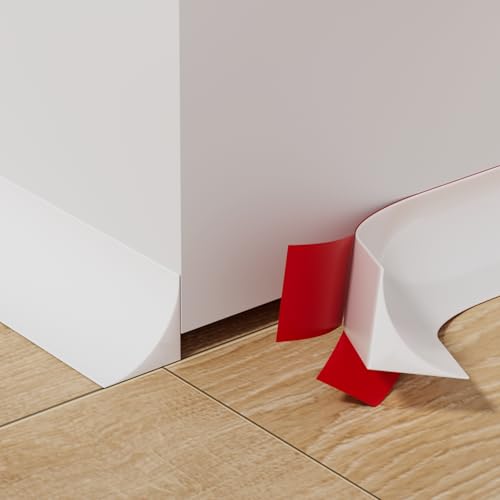
This cuysfead option offers a long 9.8-foot length with a bendable silicone rubber edge suitable for floors, walls, and edge finishes around sinks, tubs, and countertops. Best for longer runs and higher flexibility in edge work. Caution: ensure the surface is clean and dry to achieve a secure bond along extended lengths.
Best for: Long edge runs and surfaces requiring a continuous, flexible edge around corners and edges.
Buying Guide
- Material and flexibility: Silicone and rubber compounds offer better water resistance and bendability for curved edges. Choose a material that matches the room environment (dry interior vs. moisture-prone areas).
- Adhesive type: Peel-and-stick works well on smooth, clean surfaces. For rough or uneven surfaces, consider trims that can be nailed or require additional adhesive.
- Profile and size: Measure gaps and edge heights. Slim profiles are ideal for tight seams, while wider profiles cover larger gaps and provide more edge definition.
- Installation surface: Clean, dry, and smooth surfaces yield the strongest bond. Warming adhesives in cold conditions can improve bonding for some products.
- Room conditions: In cold or highly humid spaces, expect adhesives to perform differently; some products advise warming or surface pretreatment for best results.
- Durability and maintenance: Rubber and silicone trims resist moisture and cleaning agents, making them suitable for kitchens and bathrooms; PVC options may be less durable over time in high-traffic areas.
- Removal and reusability: Peel-and-stick trims are convenient to remove but may leave residue. Consider residue-removing cleaners if you plan to relocate or refinish later.
FAQ
- What is quarter round molding used for? It covers gaps and provides a finished edge along floors, walls, countertops, and cabinets, improving both appearance and moisture protection.
- Can peel-and-stick quarter round be used on curved surfaces? Some flexible versions are designed to bend around curves, but the fit depends on the product’s flexibility and surface smoothness.
- Is adhesive strength affected by cold weather? Yes, colder conditions can reduce adhesive bonding; warming the adhesive with a hairdryer can improve bond in some products.
- How do I choose the right size? Measure the gap height and edge width. Choose a profile that fully covers or complements the seam without crowding or leaving visible gaps.
- Can I install these without tools? Most peel-and-stick options require no nails or screws, just clean surfaces and basic cutting with a utility knife for sizing.
- What surfaces work best? Smooth, dry, and clean surfaces—such as painted walls, baseboards, countertops, and tiles—offer the strongest adhesion.