If you’re protecting a basement exterior, these coatings provide a durable, elastomeric barrier against water intrusion. They’re tailored for concrete, masonry, brick, and other common foundation materials, and many work above and below grade. This guide highlights five top options and explains who benefits most from each. Use the summary table to compare features, best applications, and limitations at a glance.
| Product | Best For | Key Benefit | Limitations |
|---|---|---|---|
| Ames Blue Max Liquid Rubber Waterproofer | Above- and below-grade basements | High elongation (1200%) and strong adhesion | Blue color may require repainting in some areas |
| KILZ Basement and Masonry Waterproofing Paint | Indoor/outdoor walls, masonry, concrete blocks | Nanotechnology water barrier with up to 12 PSI resistance | Not for use on active water leaks or floors |
| Daich ElastoLock Waterproof Rubber Coating | Multi-surface basements and foundations | Flexible crack bridging; moisture barrier | Coverage varies by surface; priming may be needed |
| Polar Waterproofing Sealant | Interior/exterior wood, brick, stone, concrete | Clear invisible finish; UV resistance | One-coat performance may vary by porosity |
| SHENGWEI Waterproof Sealant (3 Gal) | Large exterior or interior basement areas | High-yield coverage; transparent finish | Water-based; different curing times by climate |
Ames Blue Max Liquid Rubber Waterproofer

Best for: Basements and foundations that require a highly elastic membrane. Ames Blue Max is an adhesive, high-elasticity liquid rubber with 1200% elongation, designed to move with the substrate and resist cracking. It works on concrete, wood, metal, and more, and can be used as a primer as well as a waterproofing layer on roofs and below-grade surfaces.
Why selected: Its extreme elongation helps prevent cracking on substrates that shift or settle, making it a strong choice for exterior basement applications where movement is common. Application is versatile—brush, roll, or spray on vertical or horizontal surfaces.
Caution: The blue tint may require color adjustments or a topcoat in visible applications. Ensure proper surface prep for best adhesion on uneven or damp surfaces.
KILZ Basement and Masonry Waterproofing Paint
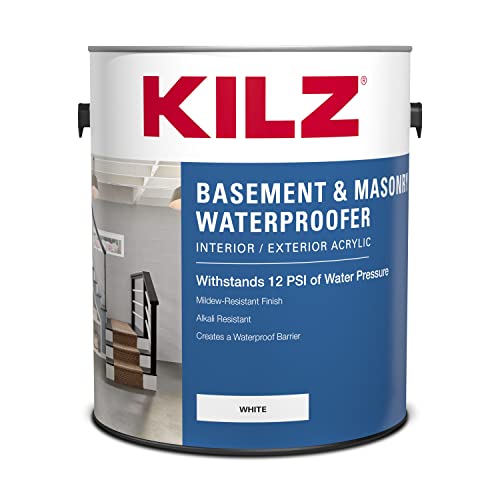
Best for: Both indoor and outdoor basement walls and masonry surfaces. KILZ uses nanotechnology to form a water barrier that blocks up to 12 PSI of water pressure, helping prevent infiltration in concrete, brick, and masonry walls.
Why selected: Its dual interior/exterior suitability and strong water-resistance make it a practical all-around option for typical basements. It integrates well with existing masonry repairs and is suitable for below-grade applications with proper crack filling beforehand.
Caution: Not recommended for floors or walls with active active leaks. Proper crack filling and surface preparation improve performance and longevity.
Daich ElastoLock Waterproof Rubber Coating

Best for: Multi-surface basements and foundation projects, including concrete, block, wood, metal, and drywall. Daich ElastoLock forms a flexible rubber membrane that blocks moisture and bridges cracks, reducing water penetration and vapor transmission.
Why selected: Its versatility across surfaces and its crack-bridging elasticity make it ideal when a single coating must perform on a varied foundation profile. It supports long-term moisture management in exterior applications.
Caution: Coverage can vary by surface porosity; some areas may require a second coat or primer for thinner surfaces to achieve uniform coverage.
Polar Waterproofing Sealant – Clear

Best for: Interior or exterior wood, brick, stone, concrete, tile, and grout. This clear, invisible sealant provides a durable barrier without altering surface appearance, and adds UV resistance for exterior use.
Why selected: The transparent finish preserves aesthetics while adding protection, making it suitable when you don’t want visible coatings altering the look of exterior walls or decorative masonry.
Caution: Achieving consistent invisibility depends on surface porosity; follow layering guidelines if multiple coats are needed for full sealant thickness.
SHENGWEI Waterproof Sealant (3 Gallon)

Best for: Large exterior or interior basement projects where a high-volume coating is advantageous. SHENGWEI delivers 360 sq ft coverage and dries to a 100% invisible finish, providing a robust moisture barrier.
Why selected: The combination of high yield and clear finish makes it suitable for sizeable spaces that require consistent protection without visible seams or color changes.
Caution: Being water-based, cure times can vary with climate; plan for adequate drying time between coats and in humid conditions.
Buying Guide
Key considerations help choose the right exterior basement waterproofing coating for your project.
- Surface type and condition: Concrete, masonry, brick, and wood each respond differently to coatings. Crack presence, porosity, and prior moisture levels influence adhesion and performance.
- Elasticity and movement: Basements experience wall movement and settling. Look for elastomeric or crack-bridging formulations that accommodate movement without cracking.
- Interior vs exterior exposure: Some coatings excel indoors or in damp basements, while others are designed for exterior weather exposure and UV resistance.
- Opacity and appearance: If aesthetics matter, consider clear or tinted options. Clear finishes preserve surface appearance but may show flaws more readily.
- Application method and coverage: Brush, roll, or spray compatibility affects labor and project size. Coverage per coat determines how many layers you’ll need to apply.
- Cure time and climate: Temperature and humidity influence drying times. Plan around weather windows for exterior projects.
Practical tips
- Proper surface prep: Clean, dry, and repair cracks before applying coatings to maximize adhesion and longevity.
- Crack treatment: For larger cracks, use a compatible sealant or hydraulic cement prior to coating to minimize moisture paths.
- Layering: Some products perform best with multiple thin coats rather than a single thick layer.
Frequently Asked Questions
- What is the difference between interior and exterior basement waterproof coatings? Interior coatings primarily halt moisture on indoor walls; exterior coatings are designed to resist driven rain, groundwater, and weather exposure on the outside of the foundation.
- Can these coatings prevent leaks in active basements? They help seal and waterproof surfaces but are not substitutes for structural repairs or active leak mitigation where hydrostatic pressure is severe.
- Do I need a primer before applying these coatings? Some products function as primers or contain bonding agents; others may require a dedicated primer on certain surfaces for best adhesion.
- How many coats should I apply? Most coatings perform better with two coats, but follow product-specific guidelines for optimal results.
- Are these coatings safe for indoor living spaces? Many are water-based and low-VOC, but verify product labels and ensure adequate ventilation during application.
- Will these coatings alter the appearance of my foundation? Clear or exterior-friendly formulations minimize changes in appearance, while pigmented options add color coverage.