Answering the question of how to achieve a cohesive three-canvas piece, this guide highlights suitable canvases and practical setup tips. Ideal buyers include beginners seeking a tri-panel project, hobbyists planning a triptych, and artists needing laid-out practice boards before final work. The following selections balance size, priming, and material to support oil, acrylic, watercolor, gouache, or tempera applications. Use this comparison to pick canvases that align with your painting style and display goals.
Summary table of selected products:
- ESRICH Canvas Boards for Painting 12×16 Inch (3 Pack) — Best for beginners and practice on a compact tri-panel
- ESRICH Stretched Canvas for Painting 24×36 Inch (3 Pack) — Best for bold, cinematic triptychs
- 3 Pack Canvases for Painting with Multi Pack 11×14, 5×7, 8×10 — Best for mixed-size triptych layouts
ESRICH Canvas Boards 12×16 — 3 Pack

Product overview: This set includes three 12×16 inch canvases made from pure cotton with a smooth surface designed to hold paints evenly. The priming is acid-free and the board core is sturdy to resist warping. These traits make the canvases well-suited for a first triptych or a small three-panel study.
Best for: Beginners who want an easy, affordable start to a three-panel composition, or artists testing color relationships on a compact tri-panel format. The 12×16 size provides enough space for detailed work without becoming unwieldy.
Why this was selected: The combination of pure cotton, smooth texture, and acid-free priming supports multiple media and reduces surface issues when painting across three connected panels. It’s an accessible entry point for practicing composition and flow across a triptych.
Caution or limitation: These are canvas boards rather than stretched canvases; slight flex may occur with heavier applications of moisture or oil, so framing or mounting as a triptych is advisable to maintain rigidity.
ESRICH Stretched Canvas 24×36 — 3 Pack
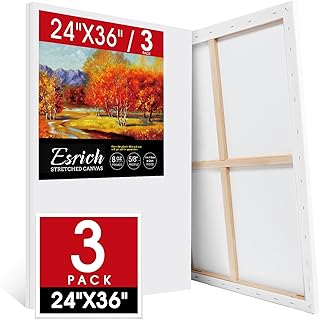
Product overview: A set of three large, pre-primed canvases measuring 24×36 inches each. The primed surface uses acid-free acrylic gesso, providing a smooth base suitable for oil, watercolor, acrylic, gouache, and tempera. The canvases are stretched over a sturdy frame, designed to stay flat during painting sessions.
Best for: Artists pursuing larger, continuous triptych works or murals with a cohesive color story spanning three expansive panels. This size is ideal for bold landscapes, abstract sequences, or narrative panels.
Why this was selected: The 24×36 format offers dramatic visual impact and allows for consistent brushwork across three connected canvases. The acid-free priming reduces yellowing and preserves the painting’s longevity across a triptych layout.
Caution or limitation: The larger surface area may require more drying time and careful handling to minimize warping or edge misalignment if not properly supported during setup.
3 Pack Canvases 11×14, 5×7, 8×10 — Multi Pack

Product overview: This trio includes canvases in three sizes: 11×14, 5×7, and 8×10, each featuring a wood frame and painted with pre-coated acid-free acrylic gesso. The frames help avoid warping and provide a reliable base for varied media applications.
Best for: Artists who want a flexible layout for a triptych that combines different panel sizes to create visual rhythm or a stepped narrative across three canvases. Great for practice in color harmony and composition across multiple formats.
Why this was selected: The range of sizes lets painters design a triptych with alternating scales, which can be visually striking. The pinewood frame adds durability, supporting a three-canvas arrangement without excessive flex.
Caution or limitation: Mixed sizes may create alignment challenges when mounting as a single, cohesive wall piece; care should be taken to align edges and spacing.
Buying Guide: Triptych Painting On Three Canvases
- Size and layout: Choose canvases that fit your display space and intended viewing distance. Larger triptychs work well as focal points in living rooms or galleries, while smaller sets suit compact bedrooms or offices.
- Material and priming: Decide between stretched canvases or boards. Stretched canvases tend to stay flatter when mounted, while boards are lighter and more affordable for experimentation.
- Media compatibility: Check primer compatibility with your preferred paints. Acid-free acrylic gesso is versatile, but oil-based media may require different preparation or sealing.
- Rigidity and mounting: For three panels, ensure consistent edge alignment. Use frames or proper hanging hardware to maintain even gaps and a seamless triptych appearance.
- Durability and care: Consider heat and humidity exposure. Cotton canvases with sturdy cores resist warping better when properly stretched or mounted.
- Cost vs long-term value: While larger, stretched canvases cost more, they often offer a finished, ready-to-han visually cohesive piece without additional framing.
FAQ
- What’s the best canvas type for a triptych? Stretched canvases provide a uniform, professional look and are easier to hang in a row. Canvas boards are lighter and more affordable for practice on three panels.
- How should I align three canvases for a triptych? Aim for equal gaps (usually 1–2 cm) and parallel alignment along the vertical edges. A level helps keep the panels evenly spaced.
- Which sizes are most versatile for a first triptych? 12×16 and 11×14 offer a balanced starting point, while 24×36 creates a dramatic, immersive piece.
- Can I use any paint on these canvases? The listed primed canvases support oils, acrylics, gouache, tempera, and watercolors to varying extents; follow media-specific preparation if needed.
- Do larger canvases require special hanging hardware? Yes. For three panels, use a picture rail or three-point hardware to distribute weight and keep alignment secure.
- Are these suitable for mixed-media triptychs? Yes, provided the media are compatible with the acrylic primer and canvas surface.