Answering the question of which continuous flow drywall tools deliver consistent results and speed, this guide highlights five top picks. These tools are best for professional finishers seeking steady material flow, precise tape and mud application, and efficient texture spraying. The top choices cover automatic finishing, taping laps, texture spraying, joint compound distribution, and skimming with extendable handles. Read on to compare who each tool is best for and why it stands out in continuous flow drywall workflows.
| Product | Best For | Why It Stands Out |
|---|---|---|
| ZÜNDER By Delko Tools | Left/right-handed taping on flat and internal joints | Double-ended applicator and durable construction allow flexible, continuous flow applications |
| LEVEL5 Automatic Drywall Taping and Finishing Tool Set | High-volume finishing on large projects | Automatic taper and multiple boxes for quick, steady coverage |
| Texture Drywall Sprayer (3 Nozzles) | Even texture distribution on walls and ceilings | Interchangeable nozzles enable consistent finishes across textures |
| Drywall Tape and Flowing Mud Dispenser Tool | Efficient joint compound application | Simultaneous tape and mud distribution for flat and corner seams |
| DEKEones Drywall Skimming Blade Set | Extending reach for large areas | Multiple blades with extension handle improve flatness and reduce lap marks |
Overview: Each tool below is described with who benefits most, how it improves workflow, and a practical limitation to consider. Use this guide to choose tools that align with your job size, texture needs, and preferred handling style.
ZÜNDER Drywall Taping Tool Banjo

Best for right- or left-handed users who need flexible taping on flat and internal joints. This tool uses a patented double-ended applicator that supports continuous flow application without frequent tool swapping. Made from durable polycarbonate ABS, it resists everyday use on job sites. The two adjustable soft-grip handles support comfortable operation on long shifts. Best for small to mid-size interiors where joint lines require precise, controlled adhesive application. Caution: The tool’s double-ended design may require a short adjustment period for first-time users to optimize alignment.
LEVEL5 Automatic Drywall Taping and Finishing Tool Set

Best for professional crews prioritizing speed and consistency on larger projects. This set centers on an automatic taper with 10”/12″ flat boxes, a 3” angle head, a 7” corner applicator, a corner roller, standard handles, a pump, and a gooseneck. It’s designed to reduce manual finishing time while maintaining quality. Choose this if finishing speed matters more than manual detail control. Caution: The system demands some setup and familiarity with automatic tools to maximize benefits.
Texture Drywall Sprayer (Knockdown, Orange Peel, Popcorn)

Best for uniform texturing across walls and ceilings with multiple texture types. The sprayer includes 3 nozzles (4.0/6.0/8.0 mm) to adapt to orange peel, knockdown, popcorn, and other finishes. Interchangeable nozzles provide control over texture density and coverage, while a robust build resists frequent use in professional settings. Caution: Sprayer performance depends on consistent material viscosity; very thick compounds may require thinning and longer curing times.
Drywall Tape And Flowing Mud Dispenser Tool

Best for efficient joint finishing where paper tape and mud meet flat surfaces and inner corners in one pass. The device supports 75 or 150 meter paper rolls and includes a built-in tape cutter for convenience. Its robust acrylic body with stainless steel and aluminum components enables straightforward cleaning and durability. Choose this if you want to reduce hand movements and streamline joint creation. Caution: Make sure the compound hardness and the tape width match your project’s standard to avoid jams.
DEKEones Drywall Skimming Blade Set
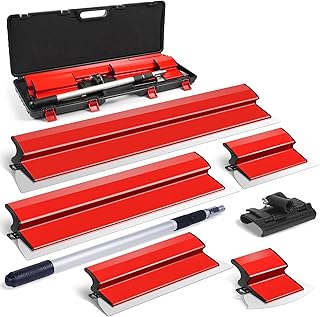
Best for extending reach on large wall areas with precision. The set includes 10″, 16″, 24″, and 32″ stainless steel blades plus a 28″-62″ extendable handle and an ergonomic grip. Blades feature rounded edges to minimize lap marks, supporting smooth, flat results. Caution: The long extension can be heavy when fully extended, so plan for shorter sessions if fatigue is a concern.
Buying Guide: Key Considerations For Continuous Flow Drywall Tools
What should you assess before buying? The following questions help align tool capabilities with job needs.
- What project size demands continuous flow efficiency? Larger projects benefit from automatic tapers and extended handles, while smaller jobs may suit manual or semi-automatic options.
- Which texture types will be applied? Sprayers with interchangeable nozzles better handle orange peel, knockdown, and popcorn textures.
- Is right- or left-handed operation a concern? Tools with dual-handed handles improve ergonomics for varied tasks.
- How important is reach and flatness in finishing? Extendable blades and long reaches help minimize lap marks and ensure uniform thickness.
- What maintenance is required? Durable materials like stainless steel and polycarbonate ABS reduce wear but may need routine cleaning after use.
Practical Comparison Of The Five Tools
- Best for flexible tapping: ZÜNDER Drywall Taping Tool Banjo
- Best for high-volume finishing: LEVEL5 Automatic Drywall Taping and Finishing Tool Set
- Better for consistent textures: Texture Drywall Sprayer with 3 Nozzles
- Choose this for joint flow: Drywall Tape And Flowing Mud Dispenser
- Best for large-area skimming: DEKEones Drywall Skimming Blade Set
FAQ
- What is continuous flow drywall tooling? It refers to tools designed to apply tape, mud, or texture in a steady, uninterrupted manner to improve efficiency and consistency.
- Which tool helps speed up finishing on large jobs? Automatic finishing and taper sets generally offer the fastest finishing workflow for big projects.
- Are interchangeable nozzles important for texture spraying? Yes; different textures require different spray densities and coverage, which nozzles enable.
- Can extendable handles reduce fatigue? Extended handles can help reach high or wide areas with less bending, but may add weight.
- Is hands-on experience necessary for automatic tools? A short learning period typically helps maximize speed and quality with automatic systems.
- What should I consider about compatibility and materials? Look for corrosion-resistant blades and durable housings for longer tool life in busy job sites.