When you need a reliable joint compound that dries quickly and reduces sanding time, these picks are best for DIYers and professional remodelers working on drywall repairs, patching, or finishing joints. The top options vary by drying speed, ease of use, and whether they function as both spackle and primer. This guide highlights five candidates, who they are best for, and why they stand out in the fast-drying category.
Summary of chosen products:
- Gorilla High Performance Wall Repair Color Change, 16 oz
- Sheetrock All Purpose Joint Compound Ready-Mixed, 1 Qt
- Sheetrock Lightweight Joint Compound- 90, 4 Lb
- DAP Fast ‘N Final Lightweight Spackling, White, 8 Oz
- DAP DryDex Lightweight Low Dust Joint Compound, Pink/White, 1 Gal
Gorilla High Performance Wall Repair Color Change
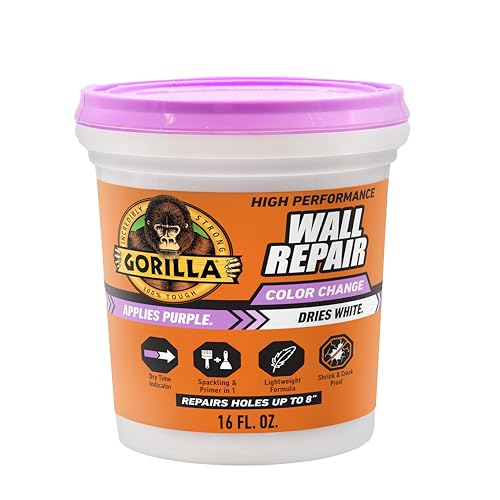
This product is best for quick patches on interior walls where you want visible drying cues. The purple-to-white color change helps confirm when sanding or painting can begin, saving time on projects with tight timelines. It combines spackling with primer-like properties for a smoother finish. Consider this option if you want a lightweight repair that sands easily and reduces mess on larger holes.
Best for: small-to-moderate holes and quick projects where color-change signaling is valuable. Caution: drying color change is helpful, but surface prep quality still affects final finish.
Sheetrock All Purpose Joint Compound Ready-Mixed

This ready-mixed joint compound is suited for interior drywall and plaster patching and finishing joints. It sands easily and provides a smooth surface suitable for taping and finishing gypsum panels. Best for: standard drywall repairs where a predictable, easy-to-smooth finish is required. Caution: may require multiple coats for deep fills; plan for sanding time accordingly.
Sheetrock Lightweight Joint Compound- 90

This lightweight formulation is designed for faster setting times. It lists a short setting window that can help accelerate project timelines. Best for: users who want quicker set times without sacrificing a smooth finish. Caution: setting times are brief; plan coats and sanding steps to avoid rushing the process.
DAP Fast ‘N Final Lightweight Spackling

Designed to patch and prime in one step, this spackling aims to deliver quick, hiding performance for painting. It uses microsphere technology for a smoother finish and low odor. Best for: time-constrained projects where a fast-drying, paint-ready surface is needed. Caution: may require longer cure times for heavier fills; test a small area first.
DAP DryDex Lightweight Joint Compound

This color-changing joint compound goes on pink and dries white, signaling when you can paint or sand. It is lightweight and designed to shrink less, reducing the number of coats needed. Best for: projects where you want a clearly visible drying cue and reduced touch-ups. Caution: for large or heavy repairs, layering may still be necessary.
Buying Guide
What should you consider when choosing a fast-drying sheetrock joint compound?
Drying speed matters, but so does workability. Look for products that indicate drying color changes, set times, and whether they work as patching compounds or primers. For larger patches, choose lightweight formulations that don’t sag and that sand easily. For quick projects, spackling-with-primer options can save steps and time.
Should you prioritize color-changing formulas?
Color-change formulas help you know when surface is ready for sanding or painting. They reduce the risk of over-sanding or applying a finish too early. This is particularly useful for DIYers or in busy job sites where timing matters.
What’s the difference between ready-mixed and powder joint compounds?
Ready-mixed compounds are convenient and consistent for patching and finishing, offering easier application without mixing. Powder-based products require mixing with water, allowing customization of consistency. For speed and simplicity, ready-mixed options are often preferred.
How important is sanding and finishing time?
Less sanding means faster completion. Look for products designed to sands smoothly with minimal effort, and consider whether they also limit shrinkage or cracking. Lightweight formulations often provide better sanding performance with less fatigue.
Are color-change products suitable for all surfaces?
Color-change compounds are typically designed for drywall and plaster joints. If you’re working on textured walls or heavily painted surfaces, test a small area first to confirm adherence and finish quality.
What about odor and ventilation?
Low-odor options are beneficial for indoor spaces with limited ventilation. If odor is a concern, choose products described as low-odor or low-emission and work with proper ventilation when sanding.
Quick-reference buying considerations
- Drying time and coat readiness signals
- Weight and sag resistance for larger repairs
- Whether it’s ready-mixed or requires mixing
- Sandability and final finish quality
- All-in-one patch-and-prime capabilities
FAQ
- Q: Which product dries fastest for small patches? A: The color-change formulations typically indicate readiness quickly, and lightweight spackling generally dries fast.
- Q: Is a color-changing compound as strong as a regular joint compound? A: Yes, many color-changing products are designed to perform similarly to standard compounds while providing a drying cue.
- Q: Can I use these on masonry or plaster walls? A: They are mainly formulated for gypsum-based drywall and plaster surfaces; test compatibility on your wall type.
- Q: Do these products require priming before painting? A: Some products include primer-like properties; others may require separate primer depending on surface conditions and finish.
- Q: How many coats are typically needed for repairs? A: It varies by patch size and product; lightweight or quick-dry formulas may require fewer coats for small fixes.
- Q: Are there odor considerations? A: Many lightweight or low-dust formulas are designed to minimize odor; check product notes for details.