For precision sanding with a mouse detail sander, choosing the right sandpaper makes a big difference in finish quality and dust control. This guide highlights five top options designed for 140mm or similar palm sanders, explaining who they’re best for and why. It helps hobbyists, DIYers, and woodworkers pick sandpaper that balances durability, surface finish, and ease of use.
Summary table of selected products:
| Product | Grit Range | Best For | Key Benefit |
|---|---|---|---|
| Coceca 50Pcs | 40–240 | Beginner to intermediate projects | Affordable assorted set with hook-and-loop backing |
| Ocasar 55Pcs | 40–240 | Dust-conscious, mid-range work | Premium grip and 5-hole dust pattern |
| Giwiemi 55Pcs | 40–800 | Finishing and polishing | Wide grit range including fine finishing grits |
| S SATC 50 PCS | 60–220 | General sanding and finishing | 12-hole design for dust extraction |
| LotFancy 50PCS | 60–220 | Compatibility with Black & Decker models | Anti-clogging and anti-static |
Coceca 50Pcs Mouse Detail Sander Sandpaper Set

The Coceca kit includes 50 sheets across five grits: 40, 80, 120, 180, and 240. Each sheet is sized for 140mm detail sanders and uses a hook-and-loop backing for quick changes. This set is best for beginners or casual hobbyists who want a budget-friendly, all-purpose assortment for wood shaping and smoothing. A minor limitation is that it covers a broad range but doesn’t emphasize ultra-fine finishing beyond 240 grit.
Ocasar 55Pcs Mouse Detail Sander Sandpaper

Ocasar’s pack emphasizes durability and clean sanding with a resin-bonded aluminum oxide surface and strong hook-and-loop backing. The 5-hole pattern supports dust extraction for a cleaner workspace, which helps during longer sessions. It’s best for users who want consistent grain support and a dependable, low-shift pad during mid-to-high precision work. A potential caveat is that high-performance use may benefit from pairing with a compatible 5-hole backing plate.
Giwiemi 55Pcs Mouse Detail Sander Sandpaper
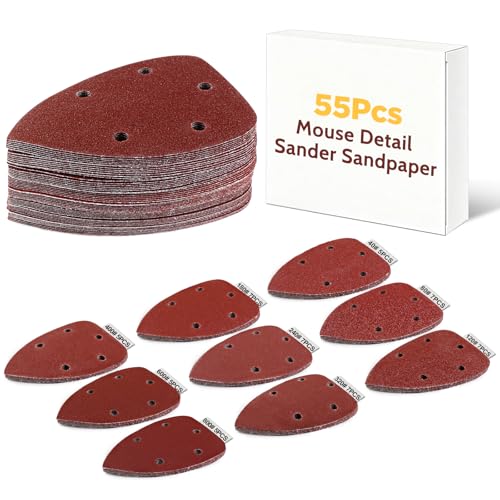
Giwiemi offers 55 pieces in nine grits from 40 to 800, providing expansive coverage for rough shaping to fine finishing. The pads are made from aluminum oxide and designed for durability and anti-static performance. This set is favored by detail work where an unusually broad grit range helps achieve smooth transitions. Choose this if you frequently switch between coarse material removal and final polishing; avoid if you need more than 800-grit for ultra-sheen finishes.
S SATC 50 PCS Mouse Detail Sander Sandpaper

This 50-pack includes grits 60, 80, 120, 150, and 220 across a 12-hole design to help achieve efficient dust removal and smoother finishes. The open-coat aluminum oxide ensures durability and anti-static properties. It’s a solid choice for general sanding projects where a wide variety of grits are needed. If your tasks lean toward ultra-fine finishing, you may want to complement with higher-grit options beyond 220.
LotFancy 50PCS Sanding Pads for Black & Decker

LotFancy’s set is tailored for Black & Decker mouse sander users, with 60/80/120/150/220 grits across 12-hole sheets. The pads emphasize anti-static and anti-clogging properties to keep dust separation efficient. This configuration is ideal for standard woodworking tasks with reliable dust extraction. Best avoided if your sander model uses a different hole pattern or backing system than 12-hole designs.
WORKPRO 150PCS Mouse Sander Pads

WORKPRO provides a large 150-piece assortment across 40/80/120/180/240 grits with a 5-hole design for effective dust extraction. The pads are aluminum oxide, anti-clogging and anti-static, with a velcro hook-and-loop backing for easy sheet changes. This kit suits serious woodworkers who want a wide range of grits and high durability in a single purchase. It may be overkill for light, occasional sanding tasks.
Buying Guide
What matters most when selecting sandpaper for a mouse detail sander?
- Grit range and finishing needs: Start with 60–120 for initial material removal, then progress to 180–240 for smoothing, and 320–800 for final finishing. Some sets cover a broader range if you frequently switch tasks.
- Backing and attachment: Hook-and-loop (velcro) backs offer quick changes. Check compatibility with your sander’s backing plate and hole pattern (12-hole vs 5-hole is common).
- Durability and dust management: Aluminum oxide is standard for durability. A 12-hole or 5-hole dust extraction design improves dust removal, reducing clogging and extending sheet life.
- Sheet size and compatibility: Ensure the sandpaper size (often around 135×95 mm or 140×100 mm) fits your specific mouse detail sander model. Mismatch can cause poor performance or slipping.
- Durability vs. cost: Larger sets with more grits deliver better value if you do frequent finishing. For occasional use, smaller assortments can suffice.
FAQ
Which grit should I start with for a new project?
Begin with a coarser grit (60–120) to remove material quickly, then move to finer grits (180–240) for smoothing, and finish with very fine grits (320–800) for a polished surface.
What hole pattern is best for dust control?
Five-hole patterns are common and pair well with many 5-hole backings; twelve-hole designs usually align with specific sander models to maximize dust extraction.
Are more pages always better?
More pages offer more grit options, but quality and compatibility matter. Choose sets that match your sander and typical projects rather than chasing quantity.
Is aluminum oxide suitable for all woods?
Aluminum oxide is versatile for many woods and paints. For extremely hard materials, you might consider ceramic or zirconia alternatives, though those are less common in detail-sander pads.
Can I mix brands in one project?
Yes, you can mix brands if grit and backing are compatible with your sander. Maintain consistent dust-extraction performance by matching hole patterns whenever possible.