Answer: For versatile, affordable painting surfaces, canvas boards (cotton, primed) offer a firm, warp-resistant alternative to stretched canvases. They’re ideal for beginners, classrooms, and quick studies, with different pack sizes to suit practice, experiments, or finished pieces. This guide compares five popular canvas board sets to help buyers choose the right balance of size, priming, and value for oil, acrylic, watercolor, or mixed media.
| Product | Size / Pack | Material | |
|---|---|---|---|
| ESRICH Canvas Boards, 12×16, 3 Pack | 12×16 in, 3 panels | 100% cotton canvas | Acid-free primer |
| ESRICH Canvas Boards, 8×10, 5 Pack | 8×10 in, 5 panels | 100% cotton canvas | Acid-free primer |
| Simetufy Canvas Boards, 8×10, 12 Pack | 8×10 in, 12 panels | 100% cotton canvas | Acid-free prime |
| KEFF Premium Canvas, 24-Pack | Multiple sizes: 5×7, 8×10, 9×12, 11×14 | 100% cotton canvas | Triple-primed |
| DPDIAN Canvas Boards, 8×10, 40-Pack | 8×10 in, 40 panels | 100% cotton canvas | Acid-free primer |
ESRICH 12×16 3-Pack Canvas

Best for beginners and small studio painters who want a stable, ready-to-use surface. The 12×16 size supports broader strokes without sacrificing detail, and the pure cotton canvas offers a smooth painting surface that holds pigment well. The interior board core minimizes warping.
- Pros: Large, versatile size; solid priming; good for oils, acrylics, watercolor, gouache, and tempera.
- Cons: Fewer panels per pack than some value sets; may be thicker than paper for ultra-light travel.
Best for: Students or hobbyists testing mixed media on one surface with room for layering.
Caution: If you aim for very large pieces, you might prefer a stretched canvas for edge-to-edge continuity.
ESRICH 8×10 5-Pack Canvas

Best for classroom use and practice sessions where many panels are needed. The 8×10 format is ideal for quick studies, still-life studies, and demonstrations. The cotton surface remains smooth and the acid-free primer helps paint grip and color payoff.
- Pros: Great value; ample surface area for school projects; holds paint well across media.
- Cons: Smaller size may limit ambitious compositions on one panel.
Best for: Teachers, clubs, or artists building up a practice inventory without sacrificing surface quality.
Caution: Ensure storage is dry to prevent any edge warping over time.
Simetufy 8×10 Canvas Boards, 12 Pack

Best for art classes and group projects where many participants contribute. The 12-pack provides a reliable stock of ready-to-paint canvases primed with acid-free acrylic gesso, suitable for acrylics, oils, tempera, and watercolor on a smooth cotton surface.
- Pros: Large pack size; consistent priming; compatible with multiple media.
- Cons: Primed surfaces may still require test swatches for certain media on very sensitive textures.
Best for: Classrooms, workshops, and practice sessions where affordability and quantity matter.
KEFF Premium Canvas, 24-Pack
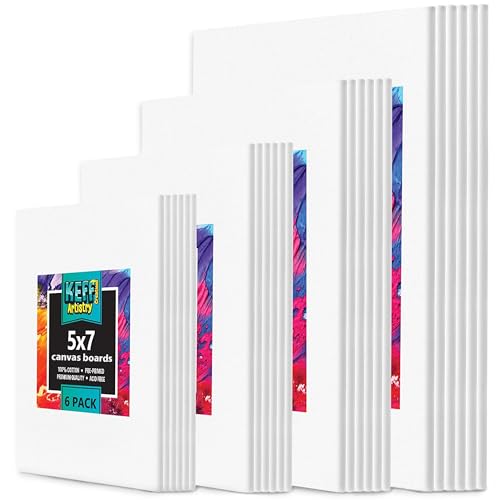
Best for comprehensive painting kits and serious hobbyists who want a full range of sizes. This set includes multiple small and medium canvases—5×7, 8×10, 9×12, and 11×14—each triple-primed for durable paint application. The variety supports both quick studies and larger compositions.
- Pros: Wide size range; triple-primed for consistent surfaces; durable for multiple media.
- Cons: Bulkier pack may be costlier upfront; smaller panels may not suit large gestures.
Best for: Art students, teachers, and home studios building a versatile, ready-to-paint collection.
Caution: Avoid exposing to excessive moisture to protect the primed surface over time.
DPDIAN 40-Pack 8×10 Canvas Boards

Best for value-focused projects and large-volume artwork. The 40-pack provides a cost-effective supply of 8×10 canvases compatible with acrylic, oil, tempera, and watercolor. The primed surface supports quick setup and immediate painting without preparation.
- Pros: Excellent per-panel value; ample supply for classrooms or studios.
- Cons: Uniform 8×10 size may require additional larger panels for bigger projects.
Best for: Instructional settings, bulk practice sessions, and artists who prefer consistent, economical panels.
Buying Guide: Canvas Board Choices For Painting
What’s the difference between canvas boards and stretched canvases?
Canvas boards are flat panels with a canvas surface mounted to a rigid base. They resist warping and are typically more affordable and portable than stretched canvases. They’re ideal for studies, practice, and pieces that don’t require a gallery-ready edge.
How do primed vs. unprimed surfaces affect painting?
Primed surfaces provide a ready-to-paint texture and prevent pigments from soaking into raw fibers. Acid-free primers protect color integrity over time. For beginners and mixed media, primed boards reduce setup time and improve color payoff.
Which surface size should I choose?
Small panels (5×7, 8×10) are great for drafts, practice, and detailed work. Mid-sized panels (9×12, 11×14) suit more ambitious compositions. Larger surfaces (12×16 and up) offer broader strokes but require more planning and storage space.
How many panels do I need?
Consider your project scope. For practice and class sets, packs of 10–40 panels offer ongoing supply. For finished studies or portfolio work, mix a few larger panels with several smaller ones.
Are cotton canvases better than synthetic options?
100% cotton canvases usually provide better texture, color absorption, and paint adhesion, especially for acrylics and oils. For watercolor, cotton with proper priming can still perform well, while synthetic fibers may offer different absorbency and stretch properties.
Which product should I buy if I’m unsure about future needs?
Opt for a versatile multi-size set with ready-to-paint primed surfaces. A value pack that includes several sizes helps you experiment with composition and media without committing to a single size.
Care and storage tips
- Store away from direct sunlight and humidity to prevent warping or color shift.
- Allow paints to dry fully between layers to avoid bleeding on the primed surface.
- Keep panels flat or lightly supported to prevent warping during storage.
FAQ
- Q: Are canvas boards suitable for oils and acrylics?
- A: Yes. Most listed boards are primed and designed for multiple media, including oils and acrylics.
- Q: What’s the advantage of a multi-pack?
- A: It provides variety in sizes for different projects and helps maintain a steady supply for practice or classroom use.
- Q: Do these boards warp?
- A: Quality boards with proper core and primer resist warping better; store flat and avoid moisture exposure.
- Q: Can I use watercolors on cotton canvas boards?
- A: Watercolor works with cotton canvases, especially when the surface is properly primed; expect different absorbency than traditional watercolor paper.
- Q: Which is best for beginners?
- A: A mixed-size set with good priming offers flexibility for learning fundamentals and exploring media.