Quick, reliable lead paint test strips help homeowners, renters, and antique collectors identify potential lead hazards on dishes, furniture, toys, ceramics, and more. This guide highlights five top options, explaining who each is best for, how they work, and practical considerations to help you choose wisely.
| Product | Best For | Key Benefit |
|---|---|---|
| NewPos Lead Test Kit | Homeowners needing fast results on diverse surfaces | Vinegar-activated, 30-second results |
| AssuTest Lead Test Kit (30 PCS) | Families wanting clear color codes | Mustard Yellow baseline for accuracy |
| AAwipes Lead Test Swabs (60) | Budget-conscious, high-quantity testing | 60-count pack, rapid 30-second results |
| Avelis 30 PCS Lead Test Kit | Everyday items in quick checks | Vinegar-activated, fast results |
| Easy@Home Lead Test Kit | Wide surface screening without vinegar in kit | 30-second color-change results; broad surface scope |
NewPos Lead Test Kit: 30 Swabs

Best for surfaces with varied textures, including dishes, ceramics, furniture, and decorative items. NewPos emphasizes an upgraded formulation and a vinegar-activated process yielding results in about 30 seconds. The color change is straightforward: red/purple/pink indicates lead; yellow means no lead detected. Use this kit when testing consumer-graded dishes and surfaces where fragility or craftsmanship matters.
Who it’s best for: households that want a quick, intuitive test on multiple types of surfaces and prefer a vinegar-activated method for accuracy. Why selected: it combines an enhanced formulation with a simple color-readout to minimize misinterpretation.
Caution: results depend on proper vinegar activation and swab technique; follow the included guidance to avoid false readings.
AssuTest Lead Test Kit: 30 PCS

Best for households seeking a clear, color-coded verdict and broad surface coverage. AssuTest uses 30 high-sensitivity swabs that indicate lead with red/purple/pink and safe surfaces with mustard yellow. It emphasizes a mustard-yellow baseline to reduce ambiguous readings and supports testing dishes, ceramics, toys, metal, wood, and more.
Who it’s best for: families that value explicit color-coding to reduce guesswork. Why selected: the mustard-yellow baseline helps stabilize readings and minimize false positives.
Limitation: as with any color-based test, lighting conditions can affect readability; ensure proper viewing conditions when interpreting results.
AAwipes Lead Test Swabs (60)

Best for budget-minded users who need many tests without sacrificing speed. This 60-count pack provides quick results in about 30 seconds. Activation uses vinegar to improve reactivity, and a color change indicates lead presence. It suits testing multiple surfaces like dishes, pottery, toys, jewelry, and metal plumbing.
Who it’s best for: large households, hobbyists, or antique enthusiasts testing several items. Why selected: high-count value pack paired with rapid results.
Caution: ensure use on surfaces where swabbing is feasible; heavy textured surfaces may require more thorough swabbing for accurate results.
Avelis 30 PCS Lead Test Kit
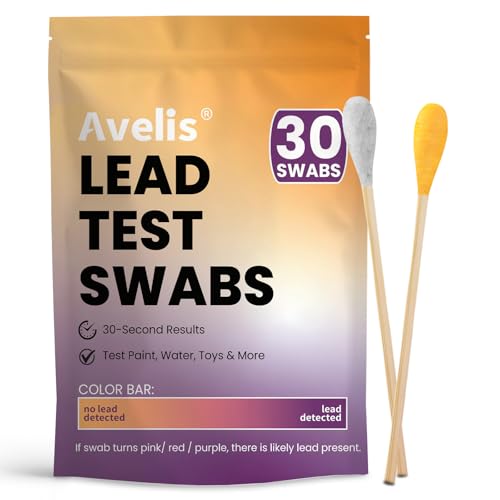
Best for daily use by homeowners who want a straightforward, vinegar-activated test with fast feedback. Avelis emphasizes vineg ar-activated testing to increase confidence in results and typically delivers results in about 30 seconds. The test readout focuses on a simple interpretation of color changes to determine lead presence.
Who it’s best for: everyday testers who value a simple, quick protocol in common household testing. Why selected: reliable vinegar-activated approach and concise result timing.
Limitation: results can depend on proper swabbing technique and activation; ensure surfaces are adequately moistened as directed.
Easy@Home Lead Test Kit

Best for broad surface screening where vinegar activation is not included in the kit documentation. Easy@Home offers a 30-second color-change readout indicating soluble surface lead. It targets painted walls, woodwork, cabinets, furniture, toys, and other exposed surfaces, making it useful for quick home audits.
Who it’s best for: users who want a wide screening tool for various household surfaces. Why selected: broad applicability and rapid results, with a straightforward pink/red color indication for lead presence.
Caution: the kit notes that it tests surface-available lead rather than internal core lead; use it as a screening tool, not a definitive lab assay.
Buying Guide: Key Purchase Considerations
- Activation method: Vinegar-activated tests can improve accuracy on porous or uneven surfaces. If you prefer a simpler approach, some kits rely on water activation, but vinegar may yield clearer results on many surfaces.
- Color interpretation: Look for kits with explicit color baselines (Mustard Yellow) and clear indicator colors (Red/Purple/Pink means lead). Consider whether you need a color-coded system to minimize misreads.
- Surface compatibility: Decide which surfaces you need to test (dishes, ceramics, wood, metal, toys, furniture). Some kits emphasize broad screening; others specialize in a subset of items.
- Sample size and cost: Larger packs (60 swabs) offer more testing opportunities at a lower per-test cost but may be less convenient if you only need occasional checks.
- Readout speed: All recommended options provide roughly 30-second results; verify if you require faster or more nuanced readings for specific items.
- Limitations: These tests screen for surface lead; they do not assess lead within internal cores of solid materials or drinking water quality. Use as part of a broader safety plan when needed.
- Storage and shelf life: Check expiration dates and storage recommendations to ensure test reliability over time.
Frequently Asked Questions
- What does a red, purple, or pink result indicate?
It indicates the presence of lead on the tested surface.
- Do these tests require any special equipment?
Most tests use a swab and a colorimetric indicator; some require vinegar for activation as described in the instructions.
- Can I test water, toys, and dishes with the same kit?
Yes, several kits are designed for multiple surfaces including dishes, toys, ceramics, and metal items; always follow the user guide for each surface type.
- Is a negative result definitive for all surfaces?
A negative result indicates no detectable surface lead under the test conditions, but it is not a substitute for professional testing in high-risk environments.
- How should I store test kits?
Store according to the manufacturer’s guidelines, typically in a cool, dry place away from direct sunlight and moisture.
- What should I do if a surface tests positive for lead?
If lead is detected, avoid contact with the item and follow local guidelines for safe handling, disposal, or remediation as appropriate.