Choosing the right color wheel watercolor palette helps artists organize hues, understand color relationships, and mix with confidence. This guide highlights five top options designed for watercolorists and includes practical notes on who each product suits best. Whether you’re a student, hobby painter, or professional, these palettes support efficient color study, easy transport, and clear mixing outcomes.
Below is a quick comparison of the highlighted products to help you decide which to consider first. The table focuses on format, primary use, and practical strengths for different painting styles.
| Product | Best For | Format | |
|---|---|---|---|
| The Color Wheel Company Watercolor Wheel | Beginners and travel painters | Plastic wheel | Clear color mixing guides for twelve core colors |
| Jack Richeson Quiller Color Wheel | Mixed media artists | Laminated wheel | Versatile for watercolor, oil, and acrylic |
| Mijello MWP-2020 Wheel Palette | In-depth color study | Plastic wheel with wells | Based on color relationships and the Munsell system |
| KOH-I-Noor Opaque Watercolor Paint Wheel | Travel and classroom use | Stackable trays | Interlocking trays with water tray cover |
| MEEDEN Large 32-Well Palette | Studio mixing | Ceramic palette | Large mixing area and deep wells |
The Color Wheel Company Watercolor Wheel

What it is: A twelve-color color wheel designed to show common color combinations at a glance. Best for: Beginners and students who want a simple, visual guide to color mixing. Why chosen: It provides straightforward reference points without requiring extensive setup. Limitation: It offers a fixed color set, which may limit deeper explorations of non-primary hues beyond the wheel’s core palette.
Jack Richeson Quiller Color Wheel

What it is: An 8.5 by 8.5-inch color wheel, laminated for durability, designed to work across watercolor, oil, and acrylic mediums. Best for: Mixed media artists who want a single reference tool for several painting styles. Why chosen: Its laminated construction stands up to frequent handling and use in classrooms or studios. Limitation: It is not a dedicated watercolor-only tool, so some color interactions may feel less specialized for watercolor alone.
Mijello MWP-2020 20 Wells Wheel Palette
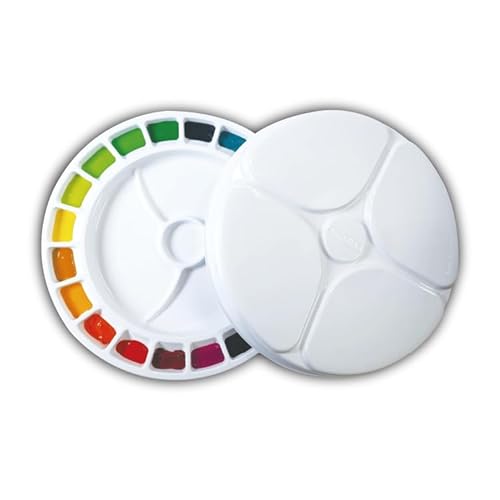
What it is: A color wheel palette with twenty wells for color study, inspired by the Munsell color system. Best for: Artists who want to study primary, secondary, and tertiary colors in depth. Why chosen: The multiple wells support more nuanced testing of mixes and shade variations. Caution: The size and number of wells require a bit more workspace and careful cleaning after use.
KOH-I-Noor Opaque Watercolor Paint Wheel

What it is: A 24-color opaque watercolor set arranged in four interlocking trays that can stack for transport. Best for: Students and educators who need a portable, modular palette. Why chosen: The design allows for compact transport and easy sharing in teaching or workshop settings. Limitation: Some users may prefer more transparent colors for watercolor layering, as opaque paints can alter transparency.
MEEDEN Large 32-Well Ceramic Palette

What it is: A large 12-3/5 by 12-3/5-inch white ceramic palette with a central mixing area and 32 wells. Best for: Studio artists who require ample mixing space and a sturdy base. Why chosen: The large surface area supports generous color testing and smooth blending. Limitation: Ceramic palettes can be heavier and require careful cleaning to avoid staining the surface over time.
Buying Guide: Color Wheel Palettes for Watercolor
What to consider when choosing a color wheel palette for watercolor:
- Color scope: Do you want a wheel focused on traditional color theory (primary, secondary, tertiary) or a broader set including opaque options?
- Medium compatibility: If you work across watercolor, gouache, acrylic, or oils, a laminated or multi-media wheel may be advantageous.
- Material and durability: Plastic wheels are lightweight and durable; ceramic palettes offer a larger mixing area but are heavier and require more care.
- Portability vs. studio use: Travel-friendly wheels and stackable trays suit field work; larger ceramic palettes fit a dedicated workspace.
- Wells and mixing space: More wells help test subtle color relationships; a central mixing area supports broader blends and tonal experiments.
- Maintenance: Laminated or non-porous surfaces resist staining; ceramic surfaces are easy to wipe but may scratch with rough tools.
Frequently Asked Questions
- What is a color wheel palette best used for in watercolor?
It helps visualize color relationships, aids in choosing harmonious mixes, and supports systematic color testing. - Should I choose a wheel with many wells or a simpler wheel?
More wells enable deeper exploration of color interactions, but a simpler wheel is quicker to reference for beginners. - Are opaque paints appropriate for watercolor wheels?
Some wheels accommodate opaque paints, but many watercolor-specific palettes focus on transparency to preserve watercolor layering effects. - Is a ceramic palette better than plastic for watercolor mixing?
Ceramic palettes provide a stable, large surface and easy cleanup, but are heavier; plastic options are lighter and highly portable. - Can a color wheel be used for other media?
Yes; certain wheels are designed for mixed media, including oil, acrylic, and gouache, offering broader applicability. - How should I care for a laminated color wheel?
Wipe with a damp cloth to remove pigment; avoid abrasive cleaners to prevent coating wear.
By selecting a palette that aligns with your painting style, workflow, and workspace, you can improve color intuition and color-mixing efficiency. Each option above offers distinct benefits—whether you value portability, a large mixing area, or multi-media compatibility—helping you find the right tool for your watercolor journey.