Whether you’re a beginner or revisiting classic techniques, choosing the right oil paints can transform your artwork. This guide highlights five reliable options that balance pigment quality, ease of use, and value. Each pick suits a different painter’s needs—from starter sets for learning color mixing to larger tubes for broad, bold strokes. Use this overview to decide which oil paints align with your project style, preferred surfaces, and technique goals.
Summary of chosen products:
- Winsor & Newton Winton Oil Color Paint Set, 20 x 12ml
- Magicfly Oil Paint, 40pcs
- RoseArt Premium Oil Paint Set, 24 Colors
- Ohuhu Oil Paint Set, 24 Colors
- MEEDEN Oil Paint Set, 12 x 22ml
Winsor & Newton Winton Oil Color Paint Set (20x12ml)

This starter set uses quality fine art pigments with a slightly stiffer consistency to retain brush and palette-knife strokes. It is best for beginners who want reliable pigment load and good coverage without a heavy expense. The uniform consistency helps maintain predictable results across washes and glazing. Best for large-volume painting and general use, especially when paired with Winsor & Newton additives for oils.
Who this is best for: students or hobbyists starting oil painting who need dependable color payoff and a straightforward workflow. Why selected: it provides a balanced palette with strong pigment load and consistent drying behavior, making it easier to learn blending and layering. Caution: it works best with compatible solvents and mediums from the same brand’s additive range to achieve extended technique options.
Magicfly Oil Paint Set, 40 Colors

This set offers a wide color range, including metallic tones, to support creative exploration and mixing. The pigments are designed to be long-lasting and non-toxic, meeting common safety standards for classroom use. The thick, creamy texture provides good coverage and smooth blending on canvases and panels. Best for: artists who want vibrant color possibilities and flexible mixing without buying multiple separate sets.
Best for: hobbyists and students who need variety and easy motivation to experiment. Caution: some colors may require careful layering to prevent muddy mixes when working with complementary hues.
RoseArt Premium Oil Paint Set, 24 Colors

RoseArt emphasizes maximum pigment strength with a smooth, buttery texture that glides across canvas, wood, or paper. The color range supports blending and layering for expressive textures. This set is positioned as premium-quality, offering strong coverage ideal for vibrant landscapes, portraits, and still lifes. Best for: artists who want bold, saturated colors with dependable blending. Caution: may require longer drying times on thicker applications, which can affect layering speed.
Ohuhu Oil Paint Set, 24 Colors
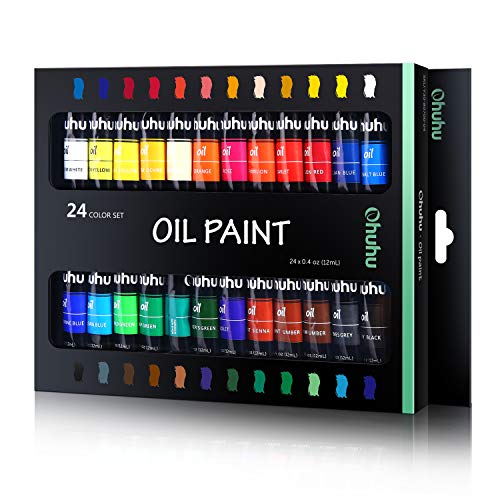
Ohuhu’s set provides a comprehensive palette of classic and modern tones, including primary colors for easy mixing. The 24 tubes are non-toxic and designed for smooth application with good coverage. This option is well suited for beginners and students who want a versatile kit for landscapes, still lifes, and portraits. Best for: those who value a broad starting color range at a reasonable price. Caution: some users may find surface shine varies with thinner layers, so testing color on scrap before glazing is helpful.
MEEDEN Oil Paint Set, 12 Colors x 22ml

MEEDEN offers a compact set with larger tubes for more ambitious projects. The pigments are ground to a fine particle size, contributing to buttery consistency and clear color separation when mixing. The set carries non-toxic credentials and is suitable for adults, students, and beginners looking to experiment with color theory and glazing. Best for: learners who want to practice color mixing with a small, manageable palette. Caution: limited color variety may require supplementary colors for complex schemes.
Winsor & Newton Winton Oil Color Basic Set (10 Tubes)

This basic set provides a smaller, affordable entry point with individually formulated colors. It is a practical choice for painters who want a curated starter palette without committing to a larger set. Best for: absolute beginners or as a travel kit for field painting. Caution: colors may have limited saturation compared to larger sets; consider adding a couple of extra tones if you plan bold, expressive work.
Buying Guide
What should you consider when choosing oil paints?
- Pigment load and coverage: Higher pigment load typically yields richer color and better glaze capabilities. Look for sets that emphasize pigment strength for long-term vibrancy.
- Consistency and handling: A slightly stiffer paint can hold brush strokes better, while creamier textures excel at blending. Decide whether you prefer brushwork control or smooth transitions.
- Drying time and film quality: Oil paints dry slowly; consider slow-drying mediums for extended blending time. Check for lightfastness and permanence if you plan to keep works long-term.
- Safety and certifications: If you work around others or have students, non-toxic formulations and standard certifications (e.g., ASTM D-4236) can be important.
- Palette and color range: Beginners benefit from sets that include primary colors plus neutrals for easy mixing. Advanced painters may prioritize specific color families (earth tones, cool/warm primaries) for efficiency.
FAQ
- Q: What is the best oil paint for beginners? A: Look for a starter set with strong pigment load, uniform consistency, and good value, such as Winton or comparable beginner-friendly ranges.
- Q: Do I need mediums or solvents with oil paints? A: Yes, many artists use mediums and solvents to modify drying time, texture, and flow. Choose compatible products from the same brand when possible.
- Q: Which paints are non-toxic? A: Many brands offer non-toxic formulations; check the product features for ASTM D-4236 or equivalent certifications.
- Q: How many colors should a beginner have? A: A core palette of 8–12 colors plus a few neutrals is typically enough to mix a wide range of hues.
- Q: How should I store oil paints? A: Keep tubes tightly closed in a cool, dry place away from direct sunlight to preserve color integrity.
- Q: Are larger tubes better for painting daily? A: Larger tubes reduce frequent restocking and can be more economical for frequent painters, especially on large works.